2012 Global Hunger Index – International Food Policy Research Institute (IFPRI)

See on Scoop.itPoverty, Hunger & Malnutrition

In this report, IFPRI describes the evidence on land, water, and energy scarcity in developing countries and offers two visions of a future global food system—an unsustainable scenario in which current trends in resource use continue, and a sustainable scenario in which access to food, modern energy, and clean water improves significantly and ecosystem degradation is halted or reversed….  http://www.ifpri.org/publication/2012-global-hunger-index

See on www.ifpri.org

Posted in Uncategorized | Leave a comment

Joel Salatin on the “Regeneration Generation” and Young Farmers

Joel Salatin on the "Regeneration Generation" and Young Farmers.

Posted in Africa, Agriciltural Policy, AR&D, Farmer, Hunger & Malnutrition | Leave a comment

Current state of agriculture and mitigation: NAMAs, quantifying emissions and links to adaptation

See on Scoop.itAgriculture, Climate & Food security

See on www.slideshare.net

Posted in Uncategorized | Leave a comment

Large support for Sustainable Livestock // FAO – Animal Production and Health

See on Scoop.itSustainable Livestock development

AGA, Animal Production and Health Division, Food and Agriculture Organization,FAO

See on www.fao.org

Posted in Uncategorized | Leave a comment

FAO – News Article: New UN food safety and nutrition standards will benefit consumers

See on Scoop.itFood supply & food safety

See on www.fao.org

Posted in Uncategorized | Leave a comment

System of root (or rice) intensification: The tales of miracle harvests

See on Scoop.itAgriculture, Climate & Food security

Nalanda district, an agricultural village in Bihar, India’s poorest state, was until recent times a placid, quiet village with no electricity and a place where farmers still favor animal power for …

See on aasw6.wordpress.com

Posted in Uncategorized | Leave a comment

Feeding Africa through Facebook

See on Scoop.itFood supply & food safety

Want to grow watermelons? Just noticed that your chickens are dying off and you don’t know what to do? Join FarmingKenya, the leading farming-related Facebook group where tips and advice are freely…

Bukar Usman (D.V.M., M.V.S.c)‘s insight:

Online efforts such as this one may just help Africa to feed itself.  Two of the site’s supporters agree that agriculture has lots of potential to create jobs, generate wealth and reduce poverty.  However, such accomplishments require farmers to become entrepreneurs. They must know where the inputs are and be linked to a good market. In describing the group they write:  “…It is an interaction of interest and hopefully through this engagement we can encourage each other to expand and improve our farming investments or start an agribusiness if we haven’t already.”

See on aasw6.wordpress.com

Posted in Uncategorized | Leave a comment

Grow good food for all : every school its schoolyard farm (Fresh Roots Urban Farm)

See on Scoop.itFood supply & food safety

AN EXAMPLE FOR ALL THE SCHOOLS IN THE DEVELOPING WORLD Read at : http://freshrootsurbancsa.wordpress.com/ Let’s Grow A Schoolyard Farm! Let us build a farm! Changing one school at a time Grow good …

See on desertification.wordpress.com

Posted in Uncategorized | Leave a comment

| World Agroforestry Centre

See on Scoop.itPoverty, Hunger & Malnutrition

Research centre (aka ICRAF) putting trees on farms to raise farmers’ income and reduce poverty, working between agriculture and forestry

See on www.worldagroforestry.org

Posted in Uncategorized | 1 Comment

Trees and food security in Africa; what’s the link? | Agroforestry World Blog

See on Scoop.itAgriculture, Climate & Food security

See on blog.worldagroforestry.org

Posted in Uncategorized | 2 Comments

| World Agroforestry Centre

See on Scoop.itAgriculture, Climate & Food security

Research centre (aka ICRAF) putting trees on farms to raise farmers’ income and reduce poverty, working between agriculture and forestry

See on www.worldagroforestry.org

Posted in Uncategorized | Leave a comment

Why does agriculture need to be Climate-Smart?

See on Scoop.itAgriculture, Climate & Food security

It is now clear, after the Fourth Assessment Report of Intergovernmental Panel on Climate Change (IPCC, 2007) that climate change poses a serious threat to growth and sustainable development in Afr…

See on aasw6.wordpress.com

Posted in Uncategorized | Leave a comment

From ‘two medicines’ to ‘One Health’ and beyond

See on Scoop.itFood supply & food safety

We first review historic and conceptual background to integrative thinking in medicine.

See on www.mendeley.com

Posted in Uncategorized | Leave a comment

AgHealth

See on Scoop.itFood supply & food safety

Prevention and control of agriculture-associated diseases

Bukar Usman (D.V.M., M.V.S.c)‘s insight:

Prevention and control of agriculture-associated diseaseWelcome to AgHealth, the website of the agriculture-associated diseases component of the CGIAR Research Program on Agriculture for Nutrition for Health.

The CGIAR Research Program on Agriculture for Nutrition for Health is led by the International Food Policy Research Institute (IFPRI) and has four research components:

Value chains for enhanced nutritionBiofortificationPrevention and control of agriculture-associated diseasesIntegrated agriculture, nutrition and health programs and policies

The International Livestock Research Institute (ILRI) leads the research component onprevention and control of agriculture-associated diseases, which has several projects under each of four major research activities:

Emerging infectious diseasesFood safetyNeglected zoonosesOne Health/Ecohealth

This site is an online portal and source of information, news and updates on ILRI’s research on agriculture-associated diseases.

Visit the News and Events pages to stay up to date with developments on various projects and related activities.


See on aghealth.wordpress.com

Posted in Uncategorized | Leave a comment

Value Chains, Linking Producers to the Markets

See on Scoop.itFood supply & food safety

See on www.slideshare.net

Posted in Uncategorized | Leave a comment

Food safety on the agenda at FARA meeting on agriculture in Africa

See on Scoop.itFood supply & food safety

In many countries of sub-Saharan Africa, informal markets play an important role in supplying most of the meat, milk, eggs and fish that poor people depend on for their nourishment. Informal market…

See on aghealth.wordpress.com

Posted in Uncategorized | Leave a comment

Role of livestock extension in the food security scenario of India- Dr.Subin Mohan

See on Scoop.itSustainable Livestock development

See on www.slideshare.net

Posted in Uncategorized | Leave a comment

Improving genetics to enhance livestock productivity

See on Scoop.itFood supply & food safety

A training workshop on advances in quantitative animal genetics and breeding evaluation procedures takes place at the International Livestock Research Institute 17th to 22nd June 2013. Led by Dr Ra…

See on peoplelivestockenvironment.wordpress.com

Posted in Uncategorized | Leave a comment

Improving nutrition through Homestead Vegetable Cultivation

See on Scoop.itFood supply & food safety

See on www.slideshare.net

Posted in Uncategorized | Leave a comment

African Civil Society Groups Protest GMO Agriculture

See on Scoop.itFood supply & food safety

Global Policy Forum is a policy watchdog that follows the work of the United Nations. We promote accountability and citizen participation in decisions on peace and security, social justice and international law.

See on www.globalpolicy.org

Posted in Uncategorized | Leave a comment

Understanding the water footprint of livestock products

Jane Gitau's avatarSustainable Livestock Digest

The amount of water in your beef depends where the animal was reared. As such, blanket condemnation of livestock products because they consume a lot of water and are therefore environment unfriendly is unjustified. This was said by Arjen Hoekstra, professor at the University of Twente, the Netherlands.

Hoeskra was addressing researchers and friends of the International Livestock Research Institute (ILRI) in a ‘livestock livetak’ at the ILRI campus in Nairobi, on February 7, 2013.

‘In some cases, such as in drylands and some pockets of wetlands, livestock keeping is the only viable option of food production and the water footprint has a low opportunity cost’, Hoekstra said.

Using the scientific colour coding for water – blue, green and grey – Hoekstra said each product has a water footprint but livestock products carry a larger footprint than crops. In the colour coding, the blue water footprint refers to the volume…

View original post 505 more words

Posted in Uncategorized | 1 Comment

African livestock records necessary

Jane Gitau's avatarSustainable Livestock Digest

Accurate record keeping of livestock details is necessary if Africa is to benefit from animal genetic improvement. For developing countries, investment in genetic improvement is worthwhile as results are accumulative and permanent, and have been shown to have one of the highest rate of returns over time. This was said by Dr Raphael Mrode, a Senior Geneticist, Animal & Veterinary Sciences, at the Scotland Rural College (SRUC), when he addressed a seminar in ILRIs Nairobi campus June 21, 2013.

Dr Mrode said while it is now possible to select the breeding values of animals and determine which ones are more economically viable, the success of that selection depends on how much information is available concerning the animal.

Countries like Australia and the United Kingdom had benefited immensely from high rates of genetic improvements for economically important traits such as milk production in the dairy sector and quality and…

View original post 423 more words

Posted in Uncategorized | Leave a comment

Africa-wide “Great Green Wall” to Halt Sahara’s Spread?

See on Scoop.itPoverty, Hunger & Malnutrition

great-green-wall-trees-senegal-sahara-desert

See on news.nationalgeographic.com

Posted in Uncategorized | Leave a comment

A global food crisis

See on Scoop.itPoverty, Hunger & Malnutrition

Aid agencies are warning donors to act now to avert another drought-related food crisis in the Sahel that could mean over 11 million people sink into further food insecurity, poverty or malnutrition.

See on www.irinnews.org

Posted in Uncategorized | Leave a comment

Food and nutrition crisis in Niger and the Western Sahel

See on Scoop.itPoverty, Hunger & Malnutrition

Stocks of millet and sorghum, locally known as Guinea corn, in northern Nigeria’s markets are dwindling as traders buy them up to export across the border to Niger, where some 10 million people face food insecurity.

See on www.irinnews.org

Posted in Uncategorized | Leave a comment

Strong African partnerships point to a brighter future for the continent

AASW editor's avatarThe FARA Social Reporters Blog

Africa is a hugely important region for CGIAR. It is no coincidence that at least 50 percent of our research budget is invested in projects on the African continent. So it was with particular pleasure that I followed progress at the High Level Meeting of African and International Leaders meeting in Addis-Ababa earlier this week (July 1st).

African leaders at the meeting, which was organized by the African Union (AU), the New Partnership for Africa’s Development (NEPAD) andtheFood and Agriculture Organization of the United Nations (FAO) amongst others, unanimously adopted a declaration to end hunger in Africa by 2025. They also reaffirmed their determination to speed up implementation of the Maputo Declaration, which calls for African countries to devote ten percent of their budget to agricultural development.

View original post 1,058 more words

Posted in Uncategorized | Leave a comment

Farming the Old-Fashioned Way Is the Newest Attack on Hunger in Africa

See on Scoop.itPoverty, Hunger & Malnutrition

Age-old techniques of tilling the land so that it replenishes itself are putting food on the table and keeping poverty at bay in Western Zambia.

See on www.takepart.com

Posted in Uncategorized | Leave a comment

World Hunger: 5 Ways to Combat the Global Crisis

See on Scoop.itPoverty, Hunger & Malnutrition

Five ways to help fight hunger around the world.

See on www.takepart.com

Posted in Uncategorized | Leave a comment

Eliminate Poverty Now: Olive Tree Pictures Produces Farmers of the Future Video

See on Scoop.itPoverty, Hunger & Malnutrition

See on judyandjohn-africa-2010.blogspot.com

Posted in Uncategorized | Leave a comment

The Science of Eating Together

See on Scoop.itFood supply & food safety

Science says eating together might be better.

See on foodtank.org

Posted in Uncategorized | Leave a comment

Trees and food security in Africa: What’s the link?

See on Scoop.itAgriculture, Climate & Food security

The right trees, coupled with the right varieties of crops, rural advisory services, and a supportive policy environment can have a huge impact on crop yields, nutrition and income in Africa. And b…

See on aasw6.wordpress.com

Posted in Uncategorized | Leave a comment

Livestock and fish program portfolio reviewed: Tackling smallholder farmers constraints

See on Scoop.itFood supply & food safety

In June, researchers and partners from CGIAR research programs, including Livestock and Fish, discussed ways to tackle the main constraints smallholder farmers face. The discussion were part of eng…

See on livestockfish.cgiar.org

Posted in Uncategorized | Leave a comment

IFAD social reporting blog: Innovative ideas to feed the world: giving a platform to young people to share ideas on ending hunger and poverty

See on Scoop.itPoverty, Hunger & Malnutrition

See on ifad-un.blogspot.be

Posted in Uncategorized | Leave a comment

Promoting organic agriculture to attract youth into agriculture

See on Scoop.itPrecision Agriculture

With up to 9.3 billion people to feed in 2050 in the world, it becomes urgent to find ways to increase agricultural productivity across Africa, the second most populated continent. One option devel…

See on aasw6.wordpress.com

Posted in Uncategorized | Leave a comment

Nigeria to train 750,000 graduates for commercial farming scheme – Minister – Premium Times Nigeria

See on Scoop.itPoverty, Hunger & Malnutrition

The Agriculture Minister said this on Monday.

Bukar Usman (D.V.M., M.V.S.c)‘s insight:

 “Realising the Potential of African Agriculture: Catalytic Innovations for Growth’’, organised by the Rockefeller Foundation, an international NGO

See on premiumtimesng.com

Posted in Uncategorized | Leave a comment

Young scientists on the realities of agricultural research in West Africa

See on Scoop.itAgriculture, Climate & Food security

I have been traveling to Ghana and Burkina Faso to visit two ILRI research fellows whom I am supervising. They are currently finishing their data collection in the field with the CGIAR Challenge Pr…

See on aasw6.wordpress.com

Posted in Uncategorized | Leave a comment

Groundbreaking ideas to help end global hunger and malnutrition (IFAD)

See on Scoop.itPoverty, Hunger & Malnutrition

Read at : http://ifad-un.blogspot.be/2013/06/innovative-ideas-to-feed-world-giving.html Innovative ideas to feed the world: giving a platform to young people to share ideas on ending hunger and pov…

See on desertification.wordpress.com

Posted in Uncategorized | Leave a comment

Agri entrepreneurs as a new type of innovators

See on Scoop.itPrecision Agriculture

Smallholders need to work the logic of markets. For that they need skills – and they do not come spontaneously. To make farming a business, farmers need specific services to help them in doing so: …

See on aasw6.wordpress.com

Posted in Uncategorized | Leave a comment

African leaders determined to end hunger by 2025

See on Scoop.itPoverty, Hunger & Malnutrition

Last week, African leaders pledged to reprioritise agriculture in their national policies and increase state spending to end hunger across the continent by 2025. At the conclusion of a meeting at t…

See on aasw6.wordpress.com

Posted in Uncategorized | Leave a comment

New database about approval for GM crops

argylesock's avatarScience on the Land

Probably the least catchy of titles belongs to the International Service for the Acquisition of Agri-biotech Applications (ISAAA). Not catchy! But these people have a lot of information to share.

This week, they announce a new database about approval for GM crops. That’s genetically modified crops, also called genetically engineered (GE) or biotech crops. ISAAA says, ‘In 2012, 170.3 million hectares of commercialized biotech crops were planted by more than 17 million farmers in 28 developing and industrial countries worldwide. These numbers are clear indications that many farmers from different agricultural conditions choose biotech crops because of the benefits they offer.’

You can get ISAAA’s newsletter delivered to your email inbox. I do. You can search the new GM database for crops or countries that interest you.

View original post

Posted in Uncategorized | Leave a comment

Growing more food using fewer natural resources: Pipe dream or the ‘only’ development pathway possible? » ILRI news

See on Scoop.itAgriculture, Climate & Food security

Bukar Usman (D.V.M., M.V.S.c)‘s insight:

Sustainable intensification, an agricultural development pathway that aims to reconcile food production and environmental protection, is a highly politicised term that divides academics and practitioners alike. Although, when first coined by Jules Pretty, the term was a way of bringing often divergent priorities such as addressing declines in land and agricultural productivity, pollution and food insecurity together under a new paradigm, it has been since accused of being a ruse for big, industrial agriculture. — Ramadjita Tabo, Sustainable intensification: A practical approach to meet Africa’s food and natural resource needs, Global Food Security blog, 18 Apr 2013


See on www.ilri.org
Posted in Uncategorized | Leave a comment

Closing the agricultural yield gap: Small-scale farmers in developing countries are where it’s at

See on Scoop.itSustainable Livestock development

Ugandan smallholder farm landscape (photo credit: Neil Palmer/CIAT). A new report from the United Nations Food and Agriculture Organization (FAO) calls for ‘more nuanced policy-making to boost smal…

See on clippings.ilri.org
Posted in Uncategorized | Leave a comment

Linking famers to (high value) livestock product markets: Opportunities and challenges in southern and eastern Africa

See on Scoop.itSustainable Livestock development

See on www.slideshare.net

Posted in Uncategorized | Leave a comment

Livestock research for Africa’s food security: Side session at 2013 Africa Agriculture Science Week » ILRI news

See on Scoop.itSustainable Livestock development

See on www.ilri.org
Posted in Uncategorized | Leave a comment

Unlocking the potential of admix local dairy cattle populations: The opportunities and frameworks for increased milk production in low input production systems

See on Scoop.itSustainable Livestock development

See on www.slideshare.net

Posted in Uncategorized | Leave a comment

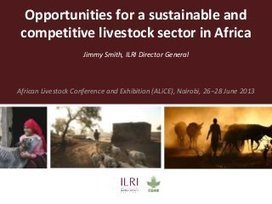
Opportunities for a sustainable and competitive livestock sector in…

See on Scoop.itSustainable Livestock development

Presented by Jimmy Smith, ILRI Director General, at the African Livestock Conference and Exhibition (ALiCE), Nairobi, 26−28 June 2013

See on www.slideshare.net

Posted in Uncategorized | Leave a comment

Of Market Power, Models and Policy Analysis

Janina's avatarFood (Policy) For Thought

With the controversy around the Food Prize, and Food Security Conference after Food Security Conference being sponsored by large seed and food corporations, it is interesting to consider how the market power of some large enterprises can influence the academic debate and shape public policy discourse.

Dr Margaret Chan, the Director-General of the World Health Organization, just opened the 8th Global Conference on Health Promotion with a speech in which she sharply denounced the influence of the private sector on setting public policy:

“In the 1980s, when we talked about multisectoral collaboration for health, we meant working together with friendly sister sectors. Like education, housing, nutrition, and water supply and sanitation. When the health and education sectors collaborate, when health works with water supply and sanitation, conflicts of interest are rarely an issue.Today, getting people to lead healthy lifestyles and adopt healthy behaviours faces opposition from forces that are…

View original post 508 more words

Posted in Uncategorized | Leave a comment

Invest in Africa’s fast-growing livestock sector: The time is now, says ILRI’s Jimmy Smith

See on Scoop.itSustainable Livestock development

Florence Chepkirui, a blind dairy farmer in Saoset village in Kenya’s Bomet District (photo credit: ILRI/Paul Karaimu). The director general of the International Livestock Institute (ILRI) has call…

Bukar Usman (D.V.M., M.V.S.c)‘s insight:

By making such investments now, we can ensure that indigenous livestock enterprises are not shut out of the rapidly increasing livestock markets by imports of animal-source foods,” Smith said

See on clippings.ilri.org
Posted in Uncategorized | Leave a comment

Farming could be key to solving youth unemployment in Africa
Posted in Uncategorized | Leave a comment

Sustainable intensification: A practical approach to meet Africa’s food and natural resource needs | Global Food Security blog

See on Scoop.itAgriculture, Climate & Food security

See on www.foodsecurity.ac.uk

Posted in Uncategorized | Leave a comment

Turning down the heat on farming – Global Food Security

See on Scoop.itAgriculture, Climate & Food security

A new web tool is helping farmers understand their emissions.

See on www.foodsecurity.ac.uk

Posted in Uncategorized | Leave a comment

When it comes to food, technology won’t save us

See on Scoop.itAgriculture, Climate & Food security

This is a great argument against the technology-driven, big-ag “food security” approach which focuses on the “need to feed the world” through more and flashier technological inventions. It addresse…

See on foodpolicyforthought.wordpress.com

Posted in Uncategorized | Leave a comment

Cracking the Nut Africa: Improving rural livelihoods and food security – Global Food Security

See on Scoop.itFood supply & food safety

Cracking the Nut Africa: Improving rural livelihoods and food security, 14-16 October 2013, Kigali, Rwanda

Bukar Usman (D.V.M., M.V.S.c)‘s insight:

ThemesProper feeding of a growing populationReducing costs and risks of serving rural clientsPreparing for sustainability of future livelihoodsEnticing investors to key agricultural value chainsFacilitating positive behavioral changes

See on www.foodsecurity.ac.uk

Posted in Uncategorized | Leave a comment

The Benefits of Organics, According to an 8-Year-Old

See on Scoop.itFood supply & food safety

When I first saw this link in my newsfeed this morning (via Butter Believer), I knew I had to share it. The video is a response to a Time Magazine article by famed TV- personality Dr. Oz, somebody …

Bukar Usman (D.V.M., M.V.S.c)‘s insight:

"Help me get my Video to Dr. Oz, share this now!" 8 year old girl.

See on foodpolicyforthought.wordpress.com

Posted in Uncategorized | Leave a comment

International conference on managing quality in chains – Global Food Security

See on Scoop.itFood supply & food safety

International conference on managing quality in chains, 2-5 September 2013, Cranfield University

See on www.foodsecurity.ac.uk

Posted in Uncategorized | Leave a comment

Free Trade Negotiations and Global Food Politics

See on Scoop.itFood supply & food safety

The United States and the European Union are currently negotiating a new free trade agreement known as the Transatlantic Free Trade Area (TFTA), sometimes also referred to as the Transatlantic Trad…

Bukar Usman (D.V.M., M.V.S.c)‘s insight:

the majority of binding and enforceable rulings of the WTO and those of other trade bodies such as the North American Free Trade Agreement (NAFTA) demonstrate a consistent pattern of lowering food, environmental, labor, or consumer safety standards in behest to trade agendas.

Trade could indeed be the vehicle through which societies are improved, jobs opportunities grown and environments strengthened. It’s time for a new, open and transparent trade model where sovereign democracy is upheld and the interests of citizens are put above those of corporations.


See on globalfoodpolitics.wordpress.com

Posted in Uncategorized | Leave a comment

First International OCHEA One Health Conference, Addis Ababa, 23-27 Sept 2013

Jeff Mariner's avatarPENAPH

PENAPH is posting this OHCEA announcement  as it should be of interest to our members. Please contact the organizers listed in the announcement for more information.

One Health Central and Eastern Africa (OHCEA), a network of 14 institutions of public health and veterinary medicine in six countries of Ethiopia, Democratic Republic of Congo, Kenya, Tanzania, Rwanda and Uganda, with USA partners University of Minnesota and Tufts University are pleased to invite submission of abstracts to the first International OHCEA One Health Conference to be held from 23rd to 27th September 2013, at Hilton Hotel, Addis Ababa, Ethiopia.

As the world faces challenges in tackling emerging and re-emerging infectious diseases, this creates a need for different disciplines, government and private sectors, developmental organisations and other stakeholders to come together to tackle the ever increasing complex problems. OHCEA, therefore, calls for abstracts from academicians, policy makers, developmental organisations, clinicians, government agencies and…

View original post 345 more words

Posted in Uncategorized | Leave a comment

FACT SHEET: Food Security in Sub-Saharan Africa | The White House

See on Scoop.itFood supply & food safety

Bukar Usman (D.V.M., M.V.S.c)‘s insight:

Feed the Future: Launched in 2010, Feed the Future is the U.S. Government’s global hunger and food security initiative.  With a focus on smallholder farmers, particularly women, and building on the standard set by the African Union when its members committed to develop comprehensive food security plans, Feed the Future is driven by country-led priorities and rooted in partnership with governments, other donor organizations, the private sector, and civil society to enable long-term success.   In addition to supporting national plans and investing in science and innovation, Feed the Future is investing in support of a goal to reduce the prevalence of poverty and stunting by 20 percent in the areas where Feed the Future works.  Today Feed the Future is releasing its 2013 Progress Report (www.feedthefuture.gov/progress), demonstrating that in 19 focus countries, Feed the Future has:

helped over 7 million smallholder farmers adopt improved agricultural technologies or practices;brought nearly 4 million hectares of land under improved cultivation and management practices;helped increase the value of exports of targeted commodities by $84 million;forged over 660 public-private partnerships to improve food security locally and globally;increased the value of agricultural and rural loans by more than $150 million.

See on www.whitehouse.gov

Posted in Uncategorized | Leave a comment

Surf or Turf: Beef vs. Fish and the Farmed Fish Debate

See on Scoop.itFood supply & food safety

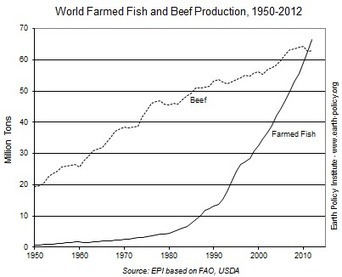
A study released by the Earth Policy Institute last week concluded that for the first time in recorded history, farmed fish production outpaced beef production. While both have been on an upward tr…

Bukar Usman (D.V.M., M.V.S.c)‘s insight:

"…farmed fish production outpaced beef production…farmed fish production has grown at an exponential rate since about 1990, rapidly closing the gap 40 million ton gap that existed just 20 years ago (see chart below). And a report by the Organization for Economic Cooperation and Development suggests that by 2015 farmed fish production may exceed wild caught fish volume." Study

See on globalfoodpolitics.wordpress.com

Posted in Uncategorized | Leave a comment

Framing Africa in the Agricultural Biotechnology Debate

See on Scoop.itPrecision Agriculture

I’m currently working on a project analyzing the use of Africa in the agricultural biotechnology debate with a couple of students. We’re looking at how proponents and opponents of biotechnology ref…

See on globalfoodpolitics.wordpress.com

Posted in Uncategorized | Leave a comment