PAEPARD: Announcement: Moderated sessions July 28-30th 2014 from USAID on Animal Science Research Priorities

Source: paepard.blogspot.com

Reducing global poverty and hunger and improving nutrition are core objectives of Feed the Future, the U.S. Government’s global hunger and food security initiative. Harnessing agricultural science and technology is critical to meeting the challenge of increasing production of more nutritious food with fewer natural resources, while adapting to climate change. The Feed the Future Research Strategy supports targeted research on sustainable intensification of plant and animal production systems and on increasing the availability of and access to nutritious foods. Livestock – including goats, sheep, cattle, pigs, poultry and fish – are central to this effort and contribute to smallholder incomes and household nutrition.

Posted in Scoop.it | Leave a comment

PAEPARD

Source: paepard.blogspot.com

The last decade of CAADP implementation, has redefined and reshaped the critical path to the attainment of Africa`s agricultural transformation objectives. Mrs. Tumusiime informed the Forum that the recent AU Joint Conference of Ministers of Agriculture, Rural Development, Fisheries and Aquaculture, held in Addis Ababa, Ethiopia, from 1st to 2nd May 2014 adopted a Resolution endorsing seven Africa Accelerated Agricultural Growth and Transformation Goals (3AGTGs) for 2025 for consideration by the AU Heads of State and Government, at their Malabo Summit.

Posted in Scoop.it | Leave a comment

PAEPARD: ALiCE2014: African Livestock Conference and Exhibition @LivestockAfrica @AnimalCareNg

Source: paepard.blogspot.com

“Small farmers need to be supported in accessing quality veterinary service especially during the out brake of livestock diseases ,more veterinary staff should be employed to ensure that in every corner of the country livestock farmers can have access to the veterinary services being offered by qualified staff,”  Dr Danilo Pezo

Posted in Scoop.it | Leave a comment

PAEPARD: ALiCE2014: African Livestock Conference and Exhibition

Source: paepard.blogspot.com

“#Livestock is currently contributing only 10%. This is very small. We need to increase the investment in the sector by about 35% and that is when the sector will be productive,”  Dr  Ndikumana

Posted in Scoop.it | Leave a comment

Small farms’ boost to food security – Business News | IOL Business | IOL.co.za

Source: www.iol.co.za

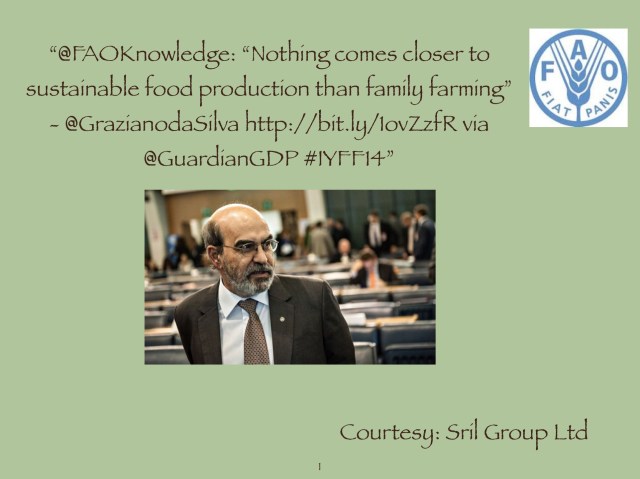
“@FAOKnowledge: Family farming is inextricably linked to national & global #foodsecurity. Key facts & figures w/ #iyff14 infographic: http://bit.ly/1saUo6D”

Posted in Scoop.it | Leave a comment

Climate change activists: your focus on food insecurity is backfiring

Jonah
Sachs: Alarming predictions will likely just grow our current system of food production,
exacerbating its environmental problems. The message should be that
our industrial food system is driving climate change

Source: www.theguardian.com

No matter how dire the facts, people still don’t seem to care enough about climate change to drive political action. If we want to make them care, we need to connect climate change to human impacts. Here’s a human impact: Climate change threatens food production. So we’ll get people to care by explaining that climate change may mean a future in which we won’t be able to produce enough food.

Posted in Scoop.it | Leave a comment

14 agricultural infographics – The rise and rise of the infographic part two

canwefeedtheworld's avatarOne Billion Hungry: Can We Feed the World?

Last year we posted a blog article about the role of infographics in communicating policy and advocacy messages in a simple, accessible and powerful way. The trend for the infographic to present big data and hard hitting facts to the masses is still growing and here are some more infographics we think you should take a look at:

  1. Oxfam Australia in their infographic, What’s wrong with our food system, look at why so many farmers are hungry.
  2. The Donald Danforth Plant Science Center documents Advances in global agriculture.
  3. Public Health Degree investigate the Two sides of the global food crisis.
  1. Online Schools compare Oil fields with corn fields in terms of their productivity and greenhouse gas emissions.
  2. The United States Agency for International Development’s infographic, The global state of agriculture, looks ahead to how we must increase food for a growing population.
  3. The International Food Policy…

View original post 163 more words

Posted in Uncategorized | Leave a comment

Next Briefing: Building resilience of SIDS through trade and agribusiness development

ctabrussels's avatarBrussels Development Briefings

The Brussels Development Briefing on ‘Building resilience of SIDS through trade and agribusiness development‘, will be held during the morning of Friday 11 July 2014, at the ACP Secretariat in Brussels. This 37th Briefing is taking place in the context of 2104 as the year of Small Island Developing States (SIDS) and the upcoming UN Conference on Small Island Developing States (1-4 September 2014, Apia, Samoa).

The panel is being organised by the ACP-EU Technical Centre for Agricultural and Rural Cooperation (CTA), in collaboration with the European Commission, the ACP Secretariat and CONCORD. It will be composed of speakers who have extensive expertise in business, trade and agriculture in ACP small islands, representing regional and international institutions, farmers’ organisations, the private sector, development partners and academia. They will discuss the vulnerabilities and challenges experienced by small islands, and explore the opportunities and achievements of the agritrade sector in…

View original post 178 more words

Posted in Uncategorized | Leave a comment

Nutrition for Growth – one year on

canwefeedtheworld's avatarOne Billion Hungry: Can We Feed the World?

nutrition for growthThe 2nd of June marked the one year anniversary of the Nutrition for Growth summit in London hosted by the UK Department for International Development, the Brazilian government and the Children’s Investment Fund Foundation. During the summit, over $4.1 billion was pledged to nutrition programmes until 2020, a financial commitment unprecedented and one that put nutrition in the spotlight. On the 2nd of June, an event hosted by the School of African and Oriental Studies entitled, Nutrition for Growth – one year on, reported progress made since the summit.

Nutrition has been gaining momentum on the international stage over the last few years: from the Lancet series on Maternal and Child Health in 2008, to the Scaling Up Nutrition movement begun in 2010, to the World Health Assembly targets on nutrition agreed in 2012. Dialogue at an international level about how to integrate nutrition in…

View original post 650 more words

Posted in Uncategorized | Leave a comment

The Guardian’s Poverty Matters blog features ILRI research on urban zoonoses

Tezira Lore's avatarAgHealth

Live hicken vendor in Vietnam A live chicken vendor weighs a chicken in Hung Yen province, Vietnam (photo credit: ILRI/Nguyen Ngoc Huyen).

An article by Mark Tran in the Guardian’s Poverty Matters blog, How to stop zoonoses spreading – don’t keep chickens under the bed, posted on 12 October 2012, highlights findings of new research from the International Livestock Research Institute (ILRI) on zoonotic diseases in urban areas and evidence-based approaches that can reduce risks and improve food safety in informal meat and milk markets.

View original post

Posted in Uncategorized | Leave a comment

International workshop to discuss an integrated approach to controlling brucellosis in Africa

See on Scoop.itSustainable Livestock development

Brucellosis, also referred to as undulant fever, is a highly contagious zoonotic disease caused by the microorganism Brucella which infects multiple animal species including cattle, sheep, pigs, sm…

See on aghealth.wordpress.com

Posted in Uncategorized | Leave a comment

Agriculture and health experts develop plan of action for aflatoxin control in Africa

See on Scoop.itFood Policy, Supply, Security & Safety

Regional and international experts in agriculture, health, research and trade have drawn up a plan of action for the control of aflatoxins in Africa, following a strategy development workshop organ…

See on aghealth.wordpress.com

Posted in Uncategorized | Leave a comment

Reducing hunger and poverty through goat ‘value chains’ in India and Mozambique

Susan MacMillan's avatarILRI Clippings

ImGoats logo

In many of the world’s dry areas, goats provide poor people with nutrition and livelihoods. An imGoats Project is working to transform the lives of goat keepers in India and Mozambique by turning their subsistence-level goat production into viable and profitable enterprises.

This two-year (2011–2012) project aims to improve the performance of small ruminant value chains in India and Mozambique so they sustainably increase household incomes and food security and reduce the vulnerability of poor goat keepers, especially women. The project will develop and test models for developing goat value chains using innovation platforms and producer hubs.

Innovation platforms provide spaces for all actors in the goat value chain—from veterinary and other input suppliers to landless producers and small-scale farmers to middlemen buyers to market sellers—to interact to improve the performance of this value chain and the benefits it generates for all the actors along it. Producer hubs allow goat…

View original post 231 more words

Posted in Uncategorized | Leave a comment

New FAO book spells out rationale, priorities for investing in livestock development to reduce poverty

See on Scoop.itSustainable Livestock development

A new FAO study reports that more than 85 per cent of poor livestock keepers in sub-Saharan Africa live in extreme poverty; here, at a Toureg encampment near Fakara, in Niger, a boy herds a prized …

Bukar Usman (D.V.M., M.V.S.c)‘s insight:

The multiple dimensions of the livestock-poverty interface, including technical, policy and political economy aspects, have been addressed and debated in disparate contexts and from different perspectives (e.g., Ahuja and Sen, 2006; FAO, 2009a; Perry and Grace, 2009; Thornton et al., 2007), but poverty has rarely been the entry point of analysis, and issues have been looked at predominantly from either the technical or the policy perspective. This has created difficulties for appreciating the intricacies of livestock-poverty relations and, consequently, for formulating policies that stimulate unambiguously pro-poor investments in the livestock sector.

See on clippings.ilri.org

Posted in Uncategorized | Leave a comment

Understanding, facilitating and monitoring agricultural innovation processes: Humidtropics holds capacity development workshop in Nairobi

Peter Ballantyne (ILRI)'s avatarILRI Clippings

Workshop participants

From 29 April to 2 May 2014, the Humidtropics CGIAR research program held a capacity development workshop in Nairobi.

Organised by the International Livestock Research Institute ILRI), Wageningen UR, and the International Institute of Tropical Agriculture (IITA), it brought together platform facilitators, Action Area Coordinators and other key-players from the research program.

The main topics of discussion were agricultural innovation systems, design and implementation of multi-stakeholder platforms (MSP), capturing knowledge and learning in MSP, and reflexive monitoring of MSPs.

Beyond mutual sharing and reflection, participants broadened their networks and gained a better understanding of the terminology and the current state of Humidtropics.

I am a natural scientist and this has been my first introduction to social sciences and it has really been an eye-opener” – Endalkachew Wolde-Meskel (N2Africa Ethiopia)

The workshop design involved an online training needs assessment, a pre and post workshop quiz, and posters capturing the…

View original post 282 more words

Posted in Uncategorized | Leave a comment

Where to Get Quality Agricultural Information Online | Big Picture Agriculture

See on Scoop.itAgriculture, Climate & Food security

Bukar Usman (D.V.M., M.V.S.c)‘s insight:

Where to Get Quality Agricultural Information Online, @e_agriculture @FAOKnowlege @ICT4Agric @CTA

See on www.bigpictureagriculture.com

Posted in Uncategorized | Leave a comment

Food safety starts at the origin

See on Scoop.itFood Policy, Supply, Security & Safety

Food safety is a major concern in human nutrition. A system of traceability in poultry processing plants will make all the movement of raw materials and processed products transparent. This prevents hazardous products ending up on the market, exposing consumers to serious health problems.

Bukar Usman (D.V.M., M.V.S.c)‘s insight:

Food safety starts with the quality and traceability of the ingedrients used in poultry diets

See on www.worldpoultry.net

Posted in Uncategorized | Leave a comment

#OIE collaborates with #IIAD and others centers to promotes global Animal Health

“The OIE is the intergovernmental organization responsible for improving animal health worldwide. It is recognized as a reference organization by the World Trade Organization (WTO) and has 180 member countries. The OIE maintains permanent relations with 51 international and regional organizations and has regional and sub-regional offices on every continent.
OIE collaborating centres represent expertise in a specific sphere of competence relating to animal health issues. As a collaborating center, IIAD will provide its expertise internationally to support and implement animal health initiatives, provide scientific and technical training, and conduct scientific research focused on global animal health. There are more than 40 collaborating centers worldwide, working in areas related to animal health, including animal welfare, food safety, vaccine development and disease surveillance” Bovine Vet

Dr. Bukar USMAN, mni's avatarSril AgroVet Ltd

#OIE collaborates with #IIAD and others centers to promotes global Animal Health

OIE collaborating centres represent expertise in a specific sphere of competence relating to animal health issues. As a collaborating center, IIAD will provide its expertise internationally to support and implement animal health initiatives, provide scientific and technical training, and conduct scientific research focused on global animal health. There are more than 40 collaborating centers worldwide, working in areas related to animal health, including animal welfare, food safety, vaccine development and disease surveillance.

View original post

Posted in Uncategorized | Leave a comment

Institute named OIE collaborating center

See on Scoop.itFood Policy, Supply, Security & Safety

The National Center for Foreign Animal and Zoonotic Disease Defense (recently renamed the Institute for Infectious Animal Diseases [IIAD]) has been recognized as a collaborating center in the specialty of biological threat reduction for the World Organization for Animal Health (OIE). This designation was made at the 82nd General Session of the OIE, held last week in Paris, France.

Bukar Usman (D.V.M., M.V.S.c)‘s insight:

OIE collaborating centres represent expertise in a specific sphere of competence relating to animal health issues. As a collaborating center, IIAD will provide its expertise internationally to support and implement animal health initiatives, provide scientific and technical training, and conduct scientific research focused on global animal health. There are more than 40 collaborating centers worldwide, working in areas related to animal health, including animal welfare, food safety, vaccine development and disease surveillance.” bovine vet online

See on www.bovinevetonline.com

Posted in Uncategorized | Leave a comment

Do not lose sight of resilience thinking in the pursuit of resilience metrics – Agriculture and Ecosystems Blog

“Critics argue that investments in building resilience with no consistent way of evaluation will fail to produce desired development outcomes.” report

http://wle.cgiar.org/blogs/2014/05/02/lose-sight-resilience-thinking-pursuit-resilience-metrics/

Posted from WordPress for Android

Posted in Uncategorized | Leave a comment

Setting Global Food Standards: What Makes Hummus, Hummus?

GlobalFoodPolitics's avatarGlobal Food Politics

Lebanese_style_hummusOver the past few years, American consumption of hummus has grown dramatically. Until the 1990s, hummus was unknown outside of specialty Middle Eastern grocers. Today, it’s in virtually every deli and grocery store across the country. It was even named the “official dip of the National Football League.”

Hummus is a simple dish of Middle Eastern origin that combines chickpeas, tahini, olive oil, lemon juice, garlic, and salt. While both Israel and Lebanon claim ownership of the dish, its exact origins remain a mystery. But growing global demand for the dish is generating some interesting politics.

Last week, Sabra, an Israeli company that dominates the US hummus market, filed a request with the Food and Drug Administration to develop standards to define hummus. The proposals would limit the use of the term “hummus” to describe dips made primarily of chickpeas and that contain a minimum of…

View original post 101 more words

Posted in Uncategorized | Leave a comment

Why is Congress Promoting Global Hunger?

GlobalFoodPolitics's avatarGlobal Food Politics

Spending ShowdownCongress is considering re-imposing requirements that at least three-quarters of all US food aid be transported on American flagged ships. The requirement, which had been reduced to half of all US food aid by the Obama administration last year, is effectively a $75 million subsidy to the US maritime industry. By requiring that American food aid be transported on US-flagged ships, the law would increase the cost of delivering food aid dramatically and slow delivery times, effectively denying food aid to an estimated 2 million recipients around the world.

Now food aid has lots of problems. In can undermine production in recipient countries, depressing prices for local farmers. Food aid shipped from the United States—regardless of the requirement to ship on US-flagged vessels—is almost always more expensive than purchasing food in the region. And US policy makers have long been clear that the primary purpose of US food aid…

View original post 302 more words

Posted in Uncategorized | Leave a comment

Researchers shut down SARS cloaking system; Findings could lead to SARS, MERS vaccines

See on Scoop.itFood Policy, Supply, Security & Safety

A research team has figured out how to disable a part of the SARS virus responsible for hiding it from the immune system — a critical step in developing a vaccine against the deadly disease. The findings also have potential applications in the creation of vaccines against other coronaviruses, including MERS.

See on www.sciencedaily.com

Posted in Uncategorized | Leave a comment

Invest More in Agriculture Not Industries

The investment should include locally tailored research….

youngfamersfoundation's avatarFoundation for Young Farmers

A very appropriate theme when Africa is rising, was one of my first thoughts. Participants were researchers, academics, policymakers from the UN, AU, governments and NGOs as well as people like me who have had to try to implement policies agreed by ‘partner countries’ and the financiers, donors.

So, an important opportunity for reaching out, exchanging views and learning from research and experiences elsewhere in the world? I left with a sense of disappointment, especially with African policymakers. I am equally disappointed with Africa’s so-called development partners who, except for the Dutch, did not even show up.

Growth in Africa is impressive these days, but it lacks the structural transformation that would mean less poverty, more jobs and prosperity. Over the last 40 years the structure of Africa’s economy has not changed. We were told the intriguing story of how Southeast Asia became the most successful region in the world…

View original post 391 more words

Posted in Uncategorized | Leave a comment

Hungry for land: big farms getting bigger and small farms getting smaller

Small farms holder = family farms = family food security = effective food security & economic livelihood = increase in Nation GDP

canwefeedtheworld's avatarOne Billion Hungry: Can We Feed the World?

ID-100131830Smallholder farmers produce the bulk of the world’s food with only minimal resources such as land and water. In fact small-scale food producers farm less than one quarter of the world’s farmland, a proportion that is declining. A new GRAIN report, Hungry for Land, investigates whether the shrinking size of land under small-scale farming poses a potential threat to the global production of food. The conclusion was clear, “we need to urgently put land back in the hands of small farmers and make the struggle for agrarian reform central to the fight for better food systems”.

As a multitude of media articles tells us land is a hot commodity, one that is fought over and one that increasingly small-scale farmers are being evicted from. Be it for large-scale oil palm plantations, the creation of protected areas or the discovery of oil, insecure systems of land tenure and opaque policy…

View original post 648 more words

Posted in Uncategorized | Leave a comment

Nutrition-sensitive agriculture: a collection of case studies

canwefeedtheworld's avatarOne Billion Hungry: Can We Feed the World?

ID-10025468A new report recently released by the United Nations Standing Committee on Nutrition, entitled, The Nutrition Sensitivity of Agriculture and Food Policies, investigates, through eight country case studies, current understanding of effective nutrition-sensitive agriculture and food policies, and the development of food-based solutions that help countries to scale up nutrition.

Recognition of the links between agriculture and nutrition is growing, and both countries and institutions are working towards making agricultural policies more nutrition sensitive. The report discusses the work of Brazil, Malawi, Mozambique, Nepal, Senegal, Sierra Leone, South Africa, and Thailand to make agriculture, a sector important for both economic development and livelihoods in many developing countries, more able to address issues of nutrition insecurity, gender inequality and resilience.

The links between agriculture and nutrition are complex, and not well understood. In particular our knowledge of how agricultural programmes or policies can impact nutritional outcomes and consumption…

View original post 392 more words

Posted in Uncategorized | Leave a comment

Cattle

jujufilms's avatarJuju Films

Cattle

Cattle | Gombe State Nigeria | JujuFilms.tv

View original post

Posted in Uncategorized | Leave a comment

Development, Public Health, and Nutrition

GlobalFoodPolitics's avatarGlobal Food Politics

mcdchinaA study commissioned by the Bill and Melinda Gates Foundation and published by the World Health Organization earlier this week reached some starting public health conclusions. The study found that the proportion of overweight and obese people increased in every country in the world between 1980 and 2013, and that nutrition-related diseases, including diabetes and pancreatic cancer, are also increasing. The report, published in the Lancet yesterday, found that globally, 36.9 percent of men and 38.0 percent of women are now overweight, increases from 28.8 percent of men and 29.8 percent of women in 1980. The study found that the fastest rate of growth in the prevalence of overweight and obesity was in the developing world. And perhaps most alarmingly, the report could not identify a single national success story—a country in which the proportion of overweight and obesity held steady or declined over the study period.

The study’s lead…

View original post 151 more words

Posted in Uncategorized | Leave a comment

“Youth Agribusiness Development Initiative”:a Private-Public partnership to Advance Youth employment in Agriculture and Agribusiness in Africa

“Despite the incentives and the expanding markets for primary and secondary agricultural commodities, the involvement of the youth in agricultural activities has steadily declined in recent years (Adekunle et al. 2009)”

Posted in Uncategorized | Leave a comment

Drop in global malnutrition depends on agricultural productivity, climate change

See on Scoop.itAgriculture, Climate & Food security

Global malnutrition could fall 84 percent by the year 2050 as incomes in developing countries grow – but only if agricultural productivity continues to improve and climate change does not severely damage agriculture, Purdue University researchers say.

Bukar Usman (D.V.M., M.V.S.c)‘s insight:

“Up to 2050, there could be some pluses for agriculture,” he said. “But in the longer run, adverse temperatures will likely become overwhelming, and rising carbon dioxide concentrations won’t help after a certain point. Eventually, you drop off a cliff.”

Read more at: http://phys.org/news/2014-05-global-malnutrition-agricultural-productivity-climate.html#jCp

See on phys.org

Posted in Uncategorized | Leave a comment

FAO and OIE boost collaboration on animal health

See on Scoop.itFood Policy, Supply, Security & Safety

FAO and OIE boost collaboration on animal health

Bukar Usman (D.V.M., M.V.S.c)‘s insight:

“OIE and FAO’s longstanding collaboration has proved its efficiency in the prevention and control of numerous animal diseases worldwide,” said OIE Director General Bernard Vallat. 

See on indiaeducationdiary.in

Posted in Uncategorized | Leave a comment

Food Security From the Ground Up – Global Food for Thought

See on Scoop.itFood Policy, Supply, Security & Safety

By Judith D. Schwartz, Author, Chelsea Green Publishing This post is part of a series produced by The Chicago Council on Global Affairs, marking the occasion of its fifth Global Food Security Symposium 2014 in Washington, DC. Taking on food security amidst the threat of increased climate instability is a formidable task. In food-producing areas around the world the best-laid plans are haunted by the specter of weather abnormalities, notably floods and drought. But once we bring land function—the ability of land to sustain plant and animal life—into the picture, we open up new strategies for building security into the…

See on globalfoodforthought.typepad.com

Posted in Uncategorized | Leave a comment

Commentary – Resilient Smallholder Farming Systems Are Vital for Global Food Security and Nutrition – Global Food for Thought

See on Scoop.itFood Policy, Supply, Security & Safety

By Shenggen Fan, Director General, International Food Policy Research Institute This post is part of a series produced by The Chicago Council on Global Affairs, marking the occasion of its fifth Global Food Security Symposium 2014 in Washington, D.C., which will be held on May 22. The growing incidence and intensity of extreme weather events and rising price volatility are cases in point of shocks that increasingly threaten the global food system. As the latest report from the Intergovernmental Panel on Climate Change (IPCC) points out, every additional decade of climate change is expected reduce average crop yields by about…

See on globalfoodforthought.typepad.com

Posted in Uncategorized | Leave a comment

Can Insects Be A Potential Tool For Global Food Security? – Science News – redOrbit

See on Scoop.itFood Policy, Supply, Security & Safety

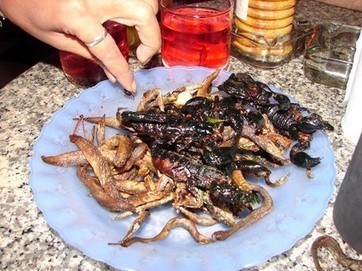
The potential of insects as human food and animal feed to assure global food security and availability of animal proteins in a sustainable way has been the main focus of the first conference Insects to feed the world in the Netherlands.

See on www.redorbit.com

Posted in Uncategorized | Leave a comment

Smallholder Farmers Most Vulnerable to Climate Change

The fact that smallholder farmers being most vulnerable to climate change, this explains why climate change is a major threat to foodsecurity!

Thought+Food's avatarThought + Food

cofcl For some time now, we have been aware that coffee farmers have been facing the challenges of climate change ; either from too much rain or from drought. Coffee crops are also being attacked by coffee rust which thrives in the warmer temperatures we are experiencing today. Colombia was one of the countries worst affected by this issue but the Colombian Coffee federation has invested on a large scale in rust resistant varieties, thus providing a solution and some hope for the farmers. In Brazil, large coffee producers have moved operations to cooler areas to combat the rising temperatures. But lost in all this is the small holder coffee farmer, often the supplier of the fair trade coffee we prefer as a better option for the planet.

While our choice at the cafe makes us feel we did the right thing, the reality might be different, with the farmer often…

View original post 202 more words

Posted in Uncategorized | Leave a comment

GAFSP: Improving Incomes, Reducing Hunger

See on Scoop.itPoverty, Hunger & Malnutrition

Results story of the Global Agriculture and Food Security Program (GAFSP) After 4 years on the ground. Strong results include drastically increased yields and extensive training for smallholder.

Bukar Usman (D.V.M., M.V.S.c)‘s insight:

"GAFSP is improving agricultural productivity, increasing incomes, and improving food security in 31 of the poorest or most malnourished countries across the globe with public and private sector development.  By supporting country-designed programs, the portfolio includes a wide range of interventions responding specifically to individual countries’ needs." – GAFSP

See on www.worldbank.org

Posted in Uncategorized | Leave a comment

Aflatoxins: New briefs disclose the threat to people and livestock and what research is doing about it

See on Scoop.itFood Policy, Supply, Security & Safety

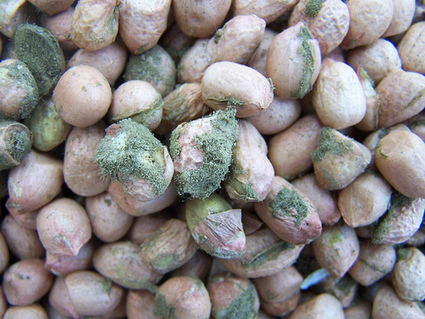
A damaged maize cob that, if harvested with clean cobs, can contaminate all the cobs with aflatoxins (photo credit: Joseph Atehnkeng/IITA). ‘The UN World Health Organization (WHO) estimates that bi…

Bukar Usman (D.V.M., M.V.S.c)‘s insight:

Increased urbanization, coupled with an upsurge in urban livestock rearing, could increase the vulnerability of animals and animal products to aflatoxin contamination, said Lindahl.

See on clippings.ilri.org

Posted in Uncategorized | Leave a comment

Farmers could cut emissions while boosting production – SciDev.Net

See on Scoop.itAgriculture, Climate & Food security

Using updated practices can cut greenhouse gas emissions and save livestock farmers money, says FAO report.

See on m.scidev.net

Posted in Uncategorized | Leave a comment

Sustainable food production: Facts and Figures – SciDev.Net

See on Scoop.itAgriculture, Climate & Food security

Farming must feed more people more sustainably. Zareen Bharucha looks at scientific approaches past and present.

See on m.scidev.net

Posted in Uncategorized | Leave a comment

Rwanda: EAX Hosts Meeting with Nigerian Minister of Agriculture

kalusam's avatarKalu Samuel's Blog

R-L Dr. Akinwunmi Adesina, Hon. Minister of Agriculture and Rural Development, Federal Republic of Nigeria and Dr. Jendayi Frazer, EAX Board Chairman R-L Dr. Akinwunmi Adesina, Hon. Minister of Agriculture and Rural Development, Federal Republic of Nigeria and Dr. Jendayi Frazer, EAX Board Chairman Photo credit: EAX

KIGALI, RWANDA – Dr. Akinwunmi Adesina, Honorable Minister of Agriculture and Rural Development, Federal Republic of Nigeria, visited the East Africa Exchange (EAX) to learn more about the exchange’s capabilities and functionality.

Dr. Adesina congratulated the EAX team for the progress that has been made since the concept of EAX was first discussed two years ago and emphasized the important role the exchange plays in creating access to markets for farmers. “The work you are doing here is remarkable and needs to be shared with the global community,” Dr. Adesina said.

Dr. Adesina invited EAX to further discuss how the Ministry can partner with EAX and EAX’s sister company, AFEX Nigeria. “I will make myself available so we can move quickly on improving warehouses and…

View original post 237 more words

Posted in Uncategorized | Leave a comment

10 reasons to invest bigger and better in agriculture in Africa | Oxfam International Blogs

See on Scoop.itAgriculture, Climate & Food security

See on blogs.oxfam.org

Posted in Uncategorized | Leave a comment

FAO – ‘Revolution’ in Agriculture Vital to Meet Food Targets

See on Scoop.itFood Policy, Supply, Security & Safety

FAO says a second “Green Revolution” may be required to boost agricultural yields and feed the world’s expected 9 billion people.

See on mask-africa.com

Posted in Uncategorized | Leave a comment

Plant intelligence

canwefeedtheworld's avatarOne Billion Hungry: Can We Feed the World?

ID-10046055 New research has shown that plants may be more intelligent than we think. A recent study conducted by the University of Western Australia, demonstrated that the plant, Mimosa pudica, could learn new behaviour and retain this memory for weeks. Mimosa pudica is a plant that when touched folds inwards, thought to be a reflex in response to predation. But when the plant was dropped several centimetres down repeatedly it quickly learnt, within minutes, that this posed no threat and stopped folding its leaves, a behaviour that persisted when plants were dropped weeks later. When shaken instead of dropped the plant would fold its leaves in response to this new threat. Watch a video of the plant’s response here .


Plant intelligence experiments are not new although earlier studies have been met with criticism for being unscientific. The 19773 book, “The Secret Life of Plants,” by Peter Tompkins and Christopher Bird…

View original post 338 more words

Posted in Uncategorized | Leave a comment

‘E-agriculture will create 500,000 jobs for youths’- Kalu Samuel

Posted in Uncategorized | Leave a comment

Video: Digital mapping for CAP 2015 unveiled

See on Scoop.itFood Policy, Supply, Security & Safety

A team of 300 IT experts is working to build a single online application and payments system in time for the new CAP scheme in 2015.

See on www.fwi.co.uk

Posted in Uncategorized | 1 Comment

Health Ranger research breakthrough: How to block nearly all the mercury in your diet using common, everyday foods

See on Scoop.itFood Policy, Supply, Security & Safety

Health Ranger research breakthrough: How to block nearly all the mercury in your diet using common, everyday foods

See on www.naturalnews.com

Posted in Uncategorized | Leave a comment

Imagining Research for Food Sovereignty (video)

FoodGovernance's avatarFood Governance

This video – Imagining Research for Food Sovereignty – highlights the outcomes of the farmer exchanges and the St Ulrich workshop deliberations.

For more information about the St. Ulrich Workshop on Democratising Agricultural Research for Food Sovereignty and Peasant Agrarian Cultures and the Democratising Food and Agricultural Research initiative go here: http://www.excludedvoices.org/st-ulrich-workshop-democratising-agricultural-research-food-sovereignty-and-peasant-agrarian-culture

View original post

Posted in Uncategorized | 1 Comment

What livestock eat (and don’t eat) determines how productive, and efficient, they are–PNAS study

Susan MacMillan's avatarILRI Clippings

Napier Grass

Napier grass (aka ‘elephant grass’), a major feed supplement for dairy cows and other ruminant animals in Kenya (photo credit: Jeff Haskins).

Even though research has shown that [greenhouse gas] GHG emissions from the Western world far outweigh those from the developing world, livestock keeping methods in Africa are increasingly becoming a key subject.

Europe, North America and Latin America are at the epicentre of beef production, with each region producing about 12 to 14 million tonnes per year. By comparison, all of sub-Saharan Africa produces less than five million tonnes of beef annually.

A new study shows ‘that most livestock in the developed world consume feeds of higher quality in form of concentrates and grains, compared to developing nations where livestock rely mainly on low quality natural pastures and crop residues. . . .

A recent International Livestock Research Institute (ILRI) study titled Biomass Use, Production, Feed efficiencies and…

View original post 496 more words

Posted in Uncategorized | Leave a comment

The whole package for Africa’s women farmers | Global Food Security blog

See on Scoop.itAgriculture, Climate & Food security

See on www.foodsecurity.ac.uk

Posted in Uncategorized | 1 Comment

African project aims to stop #rats in their tracks – SciDev.Net #postharvet

See on Scoop.itFood Policy, Supply, Security & Safety

The StopRats project will focus on helping local people make use of sustainable anti-rat technologies.

See on www.scidev.net

Posted in Uncategorized | Leave a comment

Boosting African farm yields

youngfamersfoundation's avatarFoundation for Young Farmers

For tens of millions of people in rural Africa, life has gotten harder in recent years. Reliant on erratic rains, working exhausted soil and hobbled by decades of underinvestment and neglect, many have sunk deeper into poverty as agriculture — the mainstay of the region’s economy — continues to face neglect. A growing number of African governments and UN and non-governmental agencies argue that unless urgent efforts are made to raise crop yields, build transportation and marketing systems and adopt modern, sustainable farming methods, the continent will fail to reach its development goals and the rural majority will reap only meagre harvests.

It is difficult to overestimate the importance of agriculture to Africa’s economic prospects. Some 65% of Africa’s labour force is engaged in agriculture, and the sector accounts for about 32% of the region’s GDP, according to the Alliance for a Green Revolution in Africa (AGRA), an independent organisation…

View original post 1,423 more words

Posted in Uncategorized | Leave a comment

IHAV Conference 2014- Creating an Agribusiness Revolution With Africa’s Youth.

See on Scoop.itAgriculture, Climate & Food security

  DEADLINE- May 24 2014 Conference IHAV conference is a project-based conference which will gather from across the globe, 100 outstanding and innovative African youth visionaries and 10 inspir…

See on agropreneurnaija.wordpress.com

Posted in Uncategorized | Leave a comment

Global diets get more similar in threat to food security: study

See on Scoop.itFood Policy, Supply, Security & Safety

OSLO (Reuters) – Increasing similarity in diets worldwide is a threat to health and food security with many people forsaking traditional crops such as cassava, sorghum or millet, an international study

See on www.reuters.com

Posted in Uncategorized | Leave a comment

Meat atlas – on the meat we consume and its impacts

‘‘The grain in the feed trough; Ruminants and people do not have to compete over food. But producing more meat requires ever more grain to feed to animals as concentrates” Report

Evelyn Katingi's avatarCGIAR Research Program on Livestock and Fish

Is humanity substituting the quality and safety of our meat with quantity? Published in January 2014, the Meat Atlas looks at commercial and small & medium scale meat production in the developed and developing countries and the global effects on livestock farming on livelihoods and individuals.

‘…Contribution to poverty reduction, gender quality and a healthy diet and eating meat does not have to damage the climate and the environment.

The report chapters include:

‘A species-poor planet; The genetic basis of livestock is getting ever narrower. We are relying on a few, specialized breeds of animals, such as the black-and-white Holstein-Friesian dairy cattle that are raised in over 130 countries. A few high-yielding strains also dominate the production of chickens, goats, pigs and sheep.

‘The grain in the feed trough;Ruminants and people do not have to compete over food. But producing more meat requires ever more grain to feed to…

View original post 159 more words

Posted in Uncategorized | Leave a comment

Debunking Myths Around Farming in Africa

youngfamersfoundation's avatarFoundation for Young Farmers

New technologies and ideas – from mobile phone information systems to new crop varieties – are rapidly transforming agriculture across Africa.

Yet the sector continues to be stereotyped as one synonymous with poverty and subsistence.

Simply put, people don’t believe it will pay a proper wage, let alone their children’s school fees or health bills. Farming is seen as a dead-end job, something of no interest to aspiring youth.

Following the theme of this year’s annual letter by Bill and Melinda Gates, I would like to debunk the myth that Africa’s farmers will always be poor.

In fact, there are huge opportunities for farmers. Yields of staple crops have steadily increased over the past decade and there is potential for them to increase by two or even three times more.

This would have a tremendous impact on farmers, their families, communities and economies. Research from around the world shows that…

View original post 449 more words

Posted in Uncategorized | 1 Comment

Aquaculture to Produce Majority of Global Food Fish Supply by 2030

See on Scoop.itPrecision Agriculture

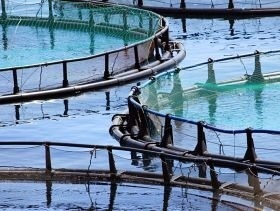
GLOBAL – Aquaculture will provide close to two thirds of global food fish consumption by 2030 as catches from wild capture fisheries level off and demand from an emerging global middle class, especially in China, substantially increases.

See on www.thefishsite.com

Posted in Uncategorized | Leave a comment

Target the curious: Bringing insect consumption to the mainstream

See on Scoop.itPrecision Agriculture

Some people are repulsed by the idea of eating insects – but those aren’t the people to target when trying to introduce insect consumption to the mainstream, says edible insect expert Professor Arnold van Huis.

See on www.foodnavigator.com

Posted in Uncategorized | Leave a comment

Why dry areas should invest massively in innovation to ensure food security / CGIAR

See on Scoop.itAgriculture, Climate & Food security

A Global Agricultural Research Partnership

See on www.cgiar.org

Posted in Uncategorized | Leave a comment

Aid to Africa: private sector investment becomes new priority. Commercial smallholders “are going to be part of the solution for the chronic poor”, EU

See on Scoop.itFood Policy, Supply, Security & Safety

Rich countries switch focus to funding businesses to help farmers and improve food security under the New Alliance

See on www.theguardian.com

Posted in Uncategorized | Leave a comment

Has Africa’s focus on farming borne fruit?

See on Scoop.itFood Policy, Supply, Security & Safety

A decade of CAADP has brought progress across the continent but too few returns on agriculture spend in most countries

See on www.theguardian.com

Posted in Uncategorized | Leave a comment