Writing about food security solutions

FoodGovernance's avatarFood Governance

ed_duncan_figure1_new-824x333

Last week we launched a Special Issue of the journal Solutions. The issue featured solutions to food security problems, as proposed by younger scholars.

Writing about solutions is much more difficult than it sounds, at least that has been our experience. Thinking about why this is, we came up with a few idea which we outlined in the editorial.

Our basic message is that as academics, we have a role to play in solution building, and part of that role is to created spaces for diverse perspectives to be represented and for these perspectives, and lived experiences, to inform the development of food security solutions. Further, we need to foster the types of skills (inside universities and outside) that prepare people to discuss, to reflect, to debate, and to weigh trade-offs associated with solutions. It becomes more clear every day that there are no silver-bullet solutions when it comes to food security.

I encourage…

View original post 10 more words

Posted in Poverty, Hunger, Malnutrition | Leave a comment

IN MY DESERTIFICATION LIBRARY: BOOK NR. 36

Willem Van Cotthem's avatarDESERTIFICATION

agriculture-food-and-nutrition-for-africa

Agriculture, food and nutrition for Africa (FAO 1997)

Posted by Prof. Dr. Willem VAN COTTHEM

Ghent University – Belgium

Having participated in all the meetings of the INCD (1992-1994) and all the meetings of the UNCCD-COP, the CST and the CRIC in 1994-2006, I had an opportunity to collect a lot of interesting books and publications on drought and desertification published in that period.

Book Nr. 36

Please click: 

https://docs.google.com/document/d/1k9HOxwdFv-awCjpq1_QTGskYLYWV8V0NY5623Ob4G1g/edit?usp=sharing

or see agriculture-food-and-nutrition-for-africa-fao-1997

View original post

Posted in Poverty, Hunger, Malnutrition | Leave a comment

What was the impact of dairy goats distributed by the crop-goat project in Tanzania?

Paul Karaimu's avatarILRI policies, instititions and livelihoods program

In Tanzania most goat production is extensive and aimed at selling live animals with limited direct impact on food security and nutrition.

The Crop and Goat Project (CGP), implemented in Kongwa and Mvomero districts, aimed at improving income, food security and nutrition of poor households by promoting dairy goat production integrated with cassava and sweet potatoes. Within the project area, village leaders generated a list of 70 potential goat recipients in each of the 4 intervention villages, based on resources and capacity. Out of these, 108 households received a total of 229 dairy goats over the project period.

This poster, produced for the Tropentag 2016 conference, highlights findings from an evaluation of the impacts of introducing dairy goats on income, assets and food consumption in the two districts in Morogoro region.

View original post

Posted in Poverty, Hunger, Malnutrition | Leave a comment

Resistance in action in the Mayan region: “NO to GMO’s”

Dirk Roep's avatarRural Sociology Wageningen University

Mayan women in a concert of the Ma OGM campaign. Source Maria Boa Mayan women in a concert of the Ma OGM campaign. Source maria Boa

August 18 María del Refugio Boa Alvarado successfully defended her MSc-thesis ‘Resistance in Action; Mobilization of Mayan beekeepers against GM soy: The case of the ‘Colectivo MA OGM‘ for the Master International Master in Rural Development. Below a post by Maria.

Are you interested on social movements? On Indigenous rights? On collectives and their practices? For years, many social scientists have been fascinated by the study of social movements and collective action. In my case, I am fascinated by the research of complex associations that frame and articulate their claims or grievances. Particularly, the processes of social transformation that have their grassroots within indigenous communities.

View original post 385 more words

Posted in Poverty, Hunger, Malnutrition | Leave a comment

As last defenses begin to fail, UN declares antibiotic resistance ‘the greatest and most urgent global risk’

Susan MacMillan's avatarILRI Clippings

mrsa-bacteria

Scanning electron micrograph of methicillin-resistant Staphylococcus aureus (MRSA) bacteria (yellow, round items) killing and escaping from a human white cell (via Flickr/NIAID).

‘An extraordinary gathering at the United Nations on September 21 may have permanently changed how the world deals with antibiotic resistance, which is believed to kill 700,000 people around the world each year.

During the UN meeting, the entire assembly signed on to a political declaration that calls antibiotic resistance “the greatest and most urgent global risk.” But it is what they do next that will determine whether the threat can really be contained.

And alarming news announced while the meeting was happening made clear how urgent it is that antibiotic resistance be reined in.

‘At a simultaneous meeting in Atlanta, the U.S. Centers for Disease Control and Prevention (CDC) disclosed that the sexually transmitted disease gonorrhea—which has become steadily more drug-resistant over several years—has taken a dramatic…

View original post 1,479 more words

Posted in Poverty, Hunger, Malnutrition | Leave a comment

The Future of Fish: Incomes, Nutrition and Global Security

GFAiR's avatarThe GFAiR Blog

bumbang-bay-indonesia Bumbang Bay, Indonesia

Melissa Benn, Associate at the Agriculture and Food Security Practice at Chemonics International, prepared this article for the September 2016 issue of WFO’s F@rmletter.

Why focus on fish?

Aquaculture is on the rise globally, and has grown at an impressive rate over the past decades, promising to play a major role in satisfying the protein requirements of both the growing global middle income group and the poorest. Currently, fish represent around 16 percent of all animal based protein consumed, and this percentage is likely to only increase.

As one of the world’s largest emerging markets, Indonesia is a great example of the challenges and potential of creating modern and competitive fisheries. Researchers with the WorldFish group evaluated growth trajectories for aquaculture in Indonesia, indicating that aquaculture will overtake capture fisheries as the major source of fish in Indonesia before 2030. Investment in aquaculture is one of the essential pathways to…

View original post 1,042 more words

Posted in Poverty, Hunger, Malnutrition | Leave a comment

ILRI presents at inaugural regional conference on zoonotic diseases in eastern Africa

Tezira Lore's avatarAgHealth

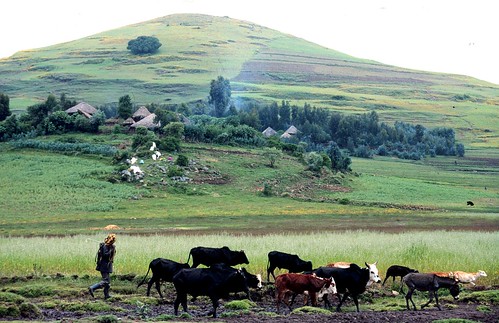
Farming in the highlands of Ethiopia Farming scene in the highlands of Ethiopia (photo credit: ILRI/Apollo Habtamu).

Zoonotic diseases, or zoonoses, are diseases that can be passed from animals to people. Nearly two-thirds of emerging infectious diseases affecting people are zoonotic and about 60% of all human pathogens are zoonotic.

Zoonoses such as brucellosis, anthrax and rabies are endemic in eastern Africa and yet formally published research studies on zoonoses in the region are hard to come by; useful research findings remain tucked away in the libraries of universities and other research institutions in form of working papers and students’ theses: the so-called ‘grey literature’.

In order to bring to the fore the wealth of unpublished research on zoonoses from studies carried out in Burundi, the Democratic Republic of the Congo, Ethiopia, Kenya, Rwanda, South Sudan, Tanzania and Uganda, the first-ever regional conference on zoonotic diseases in eastern Africa was held in Naivasha, Kenya on 9-12…

View original post 259 more words

Posted in Poverty, Hunger, Malnutrition | Leave a comment

Limiting use of antibiotics in livestock production to stem growing antimicrobial resistance in human pathogens

Susan MacMillan's avatarILRI news

UgandanChickenFarmer_CroppedA woman in Uganda lets her chickens out to forage during the day (via Flickr by Jennifer Wilmore/Bread for the World).
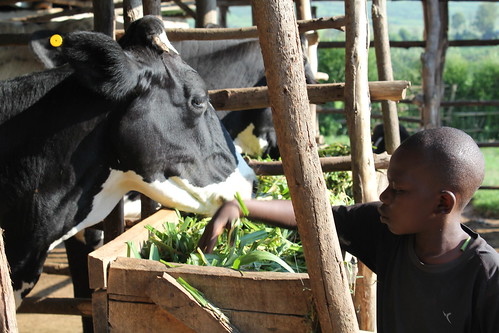
A commentary published in The Lancet last month supporting a series of five papers on antimicrobials recommends prohibiting use of antibiotics critically important for human medicine to promote the growth of livestock or to prevent routine livestock disease.

The commentary was written by Tim Robinson, a principal scientist in spatial analysis at the International Livestock Research Institute (ILRI), and colleagues in partner organizations.

‘One of the major public health challenges this century is the development of antimicrobial resistance in many important and common pathogens, such as Escherichia coli, Klebsiella pneumoniae, and Staphylococcus aureus. . . .

‘A substantial share of antimicrobial consumption is attributed to animal production.

Recent findings conservatively estimate that, from 2010 to 2030, global consumption of antimicrobials in livestock production will increase by two…

View original post 740 more words

Posted in Poverty, Hunger, Malnutrition | Leave a comment

Managing the most nutritious, and riskiest, foods in the informal markets of developing countries

Susan MacMillan's avatarILRI news

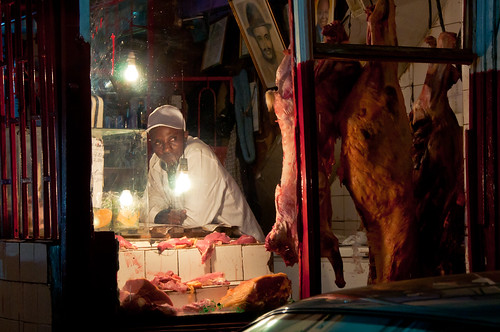
Butcher in Nairobi, Kenya

A Nairobi butcher shop after nightfall (photo credit: Flickr/Hendrik Terbeck).

A new book compiling 25 contemporary studies
on food safety in Africa’s informal markets
offers (surprising) lessons
for much of the developing world.

In case you missed it, the following excerpts are taken from an opinion piece, What’s eating sub-Saharan Africa?: New lessons in food safety and security from the food stalls of Africa’s ‘wet’ markets, published in Al Jazeera on 27 Jan 2015 and written by Delia Grace, a veterinary epidemiologist and food safety expert based in Nairobi, Kenya, at the International Livestock Research Institute (ILRI), and Kristina Roesel, coordinator of ILRI’s Safe Food, Fair Food project, based in Kampala, Uganda, and published in Al Jazeera on 27 Jan 2015.

‘Across the food-challenged regions of sub-Saharan Africa, the sustenance provided by livestock and seafood – milk, meat, eggs, and fish – is far more important than it is…

View original post 1,075 more words

Posted in Poverty, Hunger, Malnutrition | Leave a comment

Towards professionalizing—not criminalizing—informal sellers of milk and meat in poor countries

Susan MacMillan's avatarILRI news

ManWithMilkCansOnMotorcycleInTanzania

Transporting fresh milk by motorcycle in Tanzania (photo credit: ILRI/Ben Lukuyu).

‘. . . Researchers from the International Livestock Research Institute (ILRI) and partners have developed and piloted an institutional innovation—a training, certification and branding scheme for informal value chain actors—with good potential to improve the safety of animal-source foods sold in informal markets.

‘Past development policy often focused on formal markets, which at best meant neglect of informal markets and often resulted in harassment and penalties for informal agents.

While in the long term markets are likely to formalize, in the short term, interventions that seek to suppress informal markets can be both ineffective and antipoor.

‘Recent evidence suggests that a more constructive, incentive-based approach to informal markets could improve their contribution to economic development as well as increase compliance with standards in areas such as the environment, public health, and labor.

‘There is a growing recognition of…

View original post 541 more words

Posted in Poverty, Hunger, Malnutrition | Leave a comment

Improving food safety and human health through agricultural research: CGIAR future plans

Susan MacMillan's avatarILRI news

tanzanianboywithlargejugofmilk_byeadd_croppedTanzanian boy with large jug of fresh milk (photo credit: East African Dairy Development project).

A useful summary of the future plans of the CGIAR Research Program on Agriculture for Nutrition and Health (A4NH), led by the International Food Policy Research Institute (IFPRI), based in Washington, DC, has been published. Two of the five flagships of this multi-institutional research program are led or co-led by the International Livestock Research Institute (ILRI), based in Nairobi, Kenya. Future work of these two flagships is described below.

‘Beginning in 2012, the CGIAR Research Program (CRP) on Agriculture for Nutrition and Health (A4NH) has provided an innovative perspective on the relationships between agriculture, nutrition, and health through research that strengthens the knowledge base and through new partnerships that lead to outcomes. . . . Led by the International Food Policy Research Institute (IFPRI), based in Washington, D.C., A4NH’s research…

View original post 813 more words

Posted in Poverty, Hunger, Malnutrition | Leave a comment

Building a sustainable future: A history of conservation agriculture in southern Africa

GFAiR's avatarThe GFAiR Blog

thr_2-e1466715276683 Drought is increasingly common in Malawi, leaving an estimated 3 million people in need of urgent humanitarian food assistance this year alone. However, more than 400 farmers and their families in Malaka, Southern Malawi, who have been practicing CA over the last 12 years will escape hunger. CIMMYT and its partner Total LandCare have helped more than 65,000 farmers adopt CA systems throughout the entire country. Above, SIMLESA lead farmer Agnes Sendeza harvets maize ears on her farm in Tembwe, Salima Dstrict, Malawi. Photo: Peter Lowe/CIMMYT

This story is one of a series of features written during CIMMYT’s 50th anniversary year to highlight significant advancements in maize and wheat research between 1966 and 2016. It has been republished with the permission of CIMMYT.

HARARE, Zimbabwe (CIMMYT) — When practiced unsustainably, agriculture has led to environmental degradation and famine, which have plagued civilizations through the centuries. Innovations such as irrigation…

View original post 961 more words

Posted in Poverty, Hunger, Malnutrition | Leave a comment

UN OFFICIAL URGES FOCUS ON RURAL DEVELOPMENT TO LIFT MILLIONS OUT OF POVERTY

Willem Van Cotthem's avatarDESERTIFICATION

New York, Feb 22 2012  1:05PM
A top United Nations official today <“http://www.ifad.org/media/press/2012/13.htm”>committed to pull up to 90 million people out of poverty by 2015 and help small farmers and all those in rural areas to realize their potential in eliminating hunger and promoting development.

“Smallholder farmers can feed themselves and they can help feed the world,” Kanayo F. Nwanze, President of the International Fund for Agricultural Development (IFAD), said in his opening <“http://www.ifad.org/events/op/2012/gc.htm”>address to the agency’s Governing Council.

“The time has come for smallholders to play their rightful role in contributing to economic growth and food security,” he told the gathering of world leaders, global policy-makers, farmers and government ministers.

Mr. Nwanze noted that agriculture is a growth industry. With the world population expected to pass 9 billion by 2050, demand for food is guaranteed to rise in the coming years.

View original post 442 more words

Posted in Poverty, Hunger, Malnutrition | Leave a comment

The critical role of smallholder farmers and rural people

Willem Van Cotthem's avatarDESERTIFICATION

Photo credit: Google

The programme, “Accelerating Progress Toward the Economic Empowerment of Rural Women

IFAD Note Highlights Role of Rural Transformation in Achieving Post-2015 Agenda


Smallholder farmers and rural people can play a critical role in achieving the post-2015 development agenda, according to a concept note by the International Fund for Agricultural Development (IFAD). ‘Rural transformation: Key to sustainable development’ stresses the role of targeting rural areas and reducing rural-urban inequalities to achieve sustainable development and eradicate poverty and hunger.

Vietnam - Ha Giang Development Project for Ethnic Minorities -  women comprise more than 40 per cent of the agricultural labour http://www.ifad.org/media/events/2013/images/women_asia.jpg Vietnam – Ha Giang Development Project for Ethnic Minorities – women comprise more than 40 per cent of the agricultural labour – http://www.ifad.org/media/events/2013/images/women_asia.jpg

IFAD prepared the concept note in preparation for its 38th session of the Governing Council, which will focus on rural transformation as a key to sustainable development.

Rural women can be the drivers within sustainable, community-led development – they are often the ones working the most hard to feed their communities! - https://indievolunteer.files.wordpress.com/2012/10/investing-african-agriculture.jpg Rural women can be the drivers within sustainable, community-led development – they are often the ones working the most…

View original post 100 more words

Posted in Poverty, Hunger, Malnutrition | Leave a comment

How to transform rural areas so that development is not only inclusive but also socially, economically and environmentally sustainable

Willem Van Cotthem's avatarDESERTIFICATION

Read the full story: IFAD

Fostering inclusive rural transformation

Today IFAD launches Rural Development Report 2016: Fostering inclusive rural transformation. It is IFAD’s flagship publication bringing together leading thinkers to analyse lessons learnt from experiences across the globe, and to look at rural development in a new way. 

This report comes at a time of major change in the world. Structural shifts in the global economy, increased urbanization, climate change and protracted conflicts have altered the development landscape. While poverty has decreased, inequality has increased and forced displacement has become a global crisis. 

Against this backdrop, world leaders have agreed to ambitious goals to end extreme poverty and hunger by 2030. This cannot be done without developing rural areas and investing in smallholder farmers who are key to food security. 

Rural Development Report 2016 looks at how to bring rural people into the economic mainstream and how to transform…

View original post 74 more words

Posted in Poverty, Hunger, Malnutrition | Leave a comment

Joint Press Release – 2nd Pacific Agribusiness Forum

ctabrussels's avatarBrussels Development Briefings

JOINT PRESS RELEASE

Logos

2nd PACIFIC AGRIBUSINESS FORUM

LINKING THE AGRIFOOD SECTOR TO THE LOCAL MARKETS FOR ECONOMIC GROWTH AND IMPROVED FOOD AND NUTRITION SECURITY

Organised by PIPSO, CTA, IFAD, SPC and SPTO

The 2nd Pacific Agribusiness Forum held in Apia, Samoa, from 29 August to 1 September organised by the Pacific Islands Private Sector Organisation (PIPSO), the Technical Centre for Agricultural and Rural Cooperation (CTA), the International Fund for Agricultural Development (IFAD), and supported by key regional partners, has not only identified pressing challenges but mostly opportunities and creative solutions focused on the development, partnerships and strengthening of linkages within the agriculture, agritourism, health, education and finance sectors.

“On my right shoulder, you will see a gold medal. It’s our Pacific gold medal. For me it’s a symbol of what we can achieve. Small as we are, under-resourced that we are but with true Pacific spirits and resilience, we can…

View original post 767 more words

Posted in Poverty, Hunger, Malnutrition | Leave a comment

Next Brussels Briefing 46: “Agribusiness development in SIDs: the potential of tourism-related markets”

ctabrussels's avatarBrussels Development Briefings

The next Brussels Development Briefing n.46 on the subject of “Agribusiness development in SIDs: the potential of tourism-related markets” will be held in Brussels at 09:00-13:00 on 21st September 2016 at the ACP Secretariat (Avenue Georges Henri 451, 1200 Brussels).  This Briefing will be organised by the ACP-EU Technical Centre for Agricultural and Rural Cooperation (CTA), in collaboration with the European Commission / DEVCO, CONCORD and the ACP Secretariat.

View the coverage on Twitter with @BruBriefings

REGISTRATION

SIDS infographic

***

Programme and Background Note

Learn More:

Reader (available soon)

Highlights (available soon)

Photos (available soon)

Biodata of the speakers (available soon

View original post 318 more words

Posted in Poverty, Hunger, Malnutrition | Leave a comment

FAO welcomes historic commitment to end hunger in Africa by 2025 / Challenge is to transform vision into reality, Director-General says

africanpressorganization's avatarDatabase of Press Releases related to Africa - APO-Source


FAO welcomes historic commitment to end hunger in Africa by 2025 / Challenge is to transform vision into reality, Director-General says


ROME, Italy, February 2, 2014/African Press Organization (APO)/ FAO Director-General José Graziano da Silva today welcomed a breakthrough commitment by African heads of state to end hunger on the continent by 2025.


“This is the first time in history that African leaders have made such a strong pledge to eliminate hunger and it is also a show of confidence that, working together, we can win the fight against hunger in Africa in our lifetimes,” Graziano da Silva said after African Union (AU) Member States officially adopted the target at the AU Summit in Addis Ababa, Ethiopia.


“Africa is witnessing economic growth of unprecedented proportions, but it is also the only continent in the world where the total number of hungry people has gone up…

View original post 339 more words

Posted in Poverty, Hunger, Malnutrition | Leave a comment

Africa Cup of Nations to rally support for home-grown efforts to end hunger / FAO and CAF kick off “African Football against Hunger”

africanpressorganization's avatarDatabase of Press Releases related to Africa - APO-Source


Africa Cup of Nations to rally support for home-grown efforts to end hunger / FAO and CAF kick off “African Football against Hunger”


ROME, Italy, January 16, 2015/African Press Organization (APO)/ — A footballer dressed in white garb dribbles a ball across an abandoned underground construction site, laser focused, dust stirring up around him as he angles for the winning kick — he takes it and scores. The scene: part of a video ad by FAO that will be shown throughout the upcoming African Cup of Nations; the winning kick: a metaphor for overcoming hunger in Africa by 2025.


The initiative is part of “African Football Against Hunger”, a collaboration between FAO and the Confederation of African Football (CAF) to highlight the breakthrough commitment by African leaders to end hunger in the next decade.


The campaign leverages the global popularity of “footie” to spread a message…

View original post 608 more words

Posted in Poverty, Hunger, Malnutrition | Leave a comment

Four new Africa Solidarity Trust Fund projects will benefit 24 countries / Activities reflect African priorities, including youth employment and nutrition

africanpressorganization's avatarDatabase of Press Releases related to Africa - APO-Source


Four new Africa Solidarity Trust Fund projects will benefit 24 countries / Activities reflect African priorities, including youth employment and nutrition


MALABO, Equatorial Guinea, June 26, 2014/African Press Organization (APO)/ — The FAO-managed Africa Solidarity Trust Fund today gave a green light to four new, continent-spanning projects at a ceremony during the African Union Summit, being held here this week.

The President of Equatorial Guinea, Obiang Nguema Mbasogo, a key supporter of the fund, UN Secretary-General Ban Ki Moon, and FAO Director-General José Graziano da Silva were in attendance.

The projects, worth $16 million, will span 24 different countries in West, Central, East, and Southern Africa, focusing on youth employment and malnutrition, transboundary animal diseases and food safety and urban food security.

“In Africa we see the growing commitment of countries not only to improving their own food security, but that of their neighbours as well,” said FAO…

View original post 459 more words

Posted in Poverty, Hunger, Malnutrition | Leave a comment

First six countries to benefit from Africa-led fund / Africa Solidarity Trust Fund to support ongoing efforts to eradicate hunger, reduce malnutrition and poverty

africanpressorganization's avatarDatabase of Press Releases related to Africa - APO-Source


First six countries to benefit from Africa-led fund / Africa Solidarity Trust Fund to support ongoing efforts to eradicate hunger, reduce malnutrition and poverty


TUNIS, Tunisia, March 28, 2014/African Press Organization (APO)/ A unique, Africa-led fund designed to improve food security across the continent has become a reality for the first six countries slated to benefit from the initiative.

The Central African Republic, Ethiopia, Malawi, Mali, Niger and South Sudan signed agreements in Tunis with the Food and Agriculture Organization of the United Nations (FAO) to receive $2 million each from the Africa Solidarity Trust Fund.

“The Africa Solidarity Trust Fund shows that African countries are ready to step up and work with their neighbours to build a sustainable and food secure region, and to have the future we want,” said FAO Director-General José Graziano da Silva.

The agreements were signed during the FAO Regional Conference for…

View original post 411 more words

Posted in Poverty, Hunger, Malnutrition | Leave a comment

African trust fund for food security becomes reality / Equatorial Guinea provides first contribution of $30 million for “Africa for Africa” anti-hunger pool

africanpressorganization's avatarDatabase of Press Releases related to Africa - APO-Source


African trust fund for food security becomes reality / Equatorial Guinea provides first contribution of $30 million for “Africa for Africa” anti-hunger pool


ROME, Italy, February 25, 2013/African Press Organization (APO)/ Equatorial Guinea today donated $30 million to a new solidarity trust fund that aims to mobilize African financial resources in support of strengthening food security in the region.


The first donation to the Africa Solidarity Trust Fund was made official in a ceremony at the margins of the third Africa-South America Summit in Malabo, attended by FAO Director-General José Graziano da Silva.


Meeting with the President of Equatorial Guinea, Teodoro Obiang Nguema Mbasogo, before the signature of the donation agreement, Graziano da Silva said that the contribution was a sign of the country’s commitment to eradicating hunger in Africa.


FAO Regional Representative in Africa, Maria Helena Semedo, who signed the…

View original post 328 more words

Posted in Poverty, Hunger, Malnutrition | Leave a comment

Japan Steps up Support to Fight Hunger and Boost Nutrition in Africa

APO's avatarDatabase of Press Releases related to Africa - APO-Source

The United Nations World Food Programme (WFP) today welcomed a US$21.6 million cash contribution from the Government of Japan to provide vital food and nutrition assistance to the most vulnerable people in 11 countries, with 90 percent of the contribution going to 10 African nations. A large portion of the contribution will be used to purchase foodstuffs such as cereals and pulses to provide nutritious… Read more on http://africa-newsroom.com/press/japan-steps-up-support-to-fight-hunger-and-boost-nutrition-in-africa?lang=en

View original post

Posted in Poverty, Hunger, Malnutrition | Leave a comment

Impacts of value chain development on smallholder women dairy farmers in India

Peter Ballantyne (ILRI)'s avatarILRI policies, instititions and livelihoods program

In the run up to the Livestock and Fish gender working group meeting in Addis Ababa in October 2013, ILRI agro-economist Jo Cadilhon shares some ideas on the importance of gender in value chain development.

Facilitating an income-and-expenditure seasonal calendar with members of the Mulukanoor Women’s Dairy Cooperative (Photo credit: Jo Cadilhon)

I have finally realized the importance of incorporating gender into my research on value chain development. From a development perspective, numerous studies have shown how the empowerment of women (through education, increased incomes and getting a real say in household decision making) has a powerful impact on the livelihoods of households.

We, however, still need to make the connection between this wider understanding and the specifics of our value chain research. In particular, we need to gather information and data to prove that our value chain interventions have positive impacts on women.

So when the Mulukanoor women’s dairy…

View original post 677 more words

Posted in Poverty, Hunger, Malnutrition | Leave a comment

Call for papers: policies for gender-equitable participation in dairy value chains in Sub-Saharan Africa

Dorine Odongo's avatarILRI policies, instititions and livelihoods program

On 21-24 September 2014, the International Livestock Research Institute (ILRI) together with the Technical Centre for Agriculture and Rural Cooperation ACP-EU (CTA) will host an African Dairy Value Chain Seminar. The discussions of the four-day event which will be held at the Intercontinental Hotel in Nairobi will focus on three broad topics:
i. Conducive policies to foster sustainable dairy value chain development in Africa
ii. Review and assessment of methods and tools for capacity development of dairy value chain actors
iii. Review and assessment of analytical models and tools to measure the performance of dairy value chains

In a continent where women make up more than two-third of the agricultural production and livestock contributes about 30% of the gross value of agricultural production, gender issues in the dairy sector are among the important issues that must be considered in policy options.

The seminar organizers seek to…

View original post 78 more words

Posted in Poverty, Hunger, Malnutrition | Leave a comment

AGRF session on transforming dairy value chains in Africa: Pathways to prosperity

Peter Ballantyne (ILRI)'s avatarILRI policies, instititions and livelihoods program

agrf2016On 8 September 2016, the International Livestock Research Institute and partners held a working session at the 2016 African Green Revolution Forum on transforming dairy value chains in Africa: Pathways to prosperity.

Speakers from ILRI, GALVmed, Land O’Lakes and Kenya’s Ministry of Agriculture, Livestock and Fisheries tackled two main questions:

  • What are some of the promising approaches used to help smallholder dairy farmers and other value chain actors become more prosperous?
  • What are the some of the most promising lessons learned from dairy value chain transformation and productivity improvement that can be shared across the continent?

The session started with a brief orientation on dairying and development prosperity by Jimmy W. Smith, Director General, International Livestock Research Institute and Andrew K. Tuimur, Principal Secretary in the Kenyan Ministry of Agriculture, Livestock and Fisheries.

The focus then shifted to lessons and experiences transforming dairy value chains. Isabelle Baltenweck (ILRI) introduced the…

View original post 536 more words

Posted in Poverty, Hunger, Malnutrition | Leave a comment

IN MY DESERTIFICATION LIBRARY: BOOK NR. 31

Willem Van Cotthem's avatarDESERTIFICATION

nutrition-and-food-production-in-congo

Nutrition and Food Production in the Congo Basin (2014)

Posted by Prof. Dr. Willem VAN COTTHEM

Ghent University – Belgium

Having participated in all the meetings of the INCD (1992-1994) and all the meetings of the UNCCD-COP, the CST and the CRIC in 1994-2006, I had an opportunity to collect a lot of interesting books and publications on drought and desertification published in that period.

Book Nr. 31

Please click: 

https://docs.google.com/document/d/1bOD_4DjhJo_mgvP8UxB-I5DFgB4qfYcmeVrZrajy4Vg/edit?usp=sharing

or see nutrition-and-food-production-in-the-congo-basin-2014

View original post

Posted in Poverty, Hunger, Malnutrition | Leave a comment

Tropentag workshop: Empowering livestock and fish smallholders through multi-stakeholder platforms and value chains

Peter Ballantyne (ILRI)'s avatarCGIAR Research Program on Livestock and Fish

On 19 September 2016, ’empowering livestock and fish smallholders through multi-stakeholder platforms and value chains’  is the focus of a Livestock and Fish research program workshop at the Tropentag 2016 conference.

Guided by the Tropentag theme ‘Solidarity in a competing world’, the workshop will synthesize experiences and lessons of the program and its partners, focusing on food security, livelihoods and empowerment towards a fairer, more sustainable world.

Since 2012, CGIAR Livestock and Fish program partners have worked in a solution-driven approach to agricultural research for development. This combines technical upstream interventions in animal health, animal feeding and animal genetics with multi-stakeholder interventions with communities and along value chains. Special attention is given to inclusive value chain development, by and for the poor, targeting women and people facing environmental and public health issues.

Drawing on experiences from several ‘value chain’ countries as well as livestock and fish technical specialists, the workshop…

View original post 72 more words

Posted in Poverty, Hunger, Malnutrition | Leave a comment

Hundreds of Millions Face Health Risk as Water Pollution Rises Across Three Continents

APO's avatarDatabase of Press Releases related to Africa - APO-Source

· Pathogen and organic pollution rises in more than 50% of river stretches in Africa, Asia and Latin America · Asia hit hardest by rise in severe pathogen pollution with up to a half of all river stretches affected · Up to 323 million people on three continents at risk of infection from diseases caused by pathogens in water Water pollution has risen across three continents, placing hundreds of… Read more on http://africa-newsroom.com/press/hundreds-of-millions-face-health-risk-as-water-pollution-rises-across-three-continents?lang=en

View original post

Posted in Poverty, Hunger, Malnutrition | Leave a comment

Taking Camel Milk is a Way to Flush Your Body Clean of Toxins While Making You Strong and Shining

Dr Raziq Kakar's avatarNatural Health with the Camel Milk

A gift of nature and gold of desert, the camel milk (CM) is miraculously proving as a superfood and natural flush. Because of the appreciable level and unique combination of nutrients (minerals, vitamins, protein, and fatty acids etc.), CM has medicinal properties covering a wide range of ailments. Such ailments wide in range and comprising of autoimmune diseases, allergies, asthma, rashes, diabetes, liver disorders, rheumatism, inflammatory conditions, piles, urethral irritation, infectious diseases, stress/depression, peptic ulcers and even cancer.

Image result for camel milk products emirates camelait Camelait! a pasteurized milk

The manifolds enriched levels of minerals (potassium, magnesium, iron, copper, manganese, sodium and zinc) than cow milk, making it a strong flush for body toxins. The flushing of toxins is the utmost need of time as we are taking toxins from the poisonous croplands. The Poisonous Fields

Not in the Mood? A Tonic for Mature People

Camel milk is use as the aphrodisiac, especially in the stressful conditions of…

View original post 689 more words

Posted in Poverty, Hunger, Malnutrition | Leave a comment

Stronger together: unlocking Africa’s food production potential — THE GFAR BLOG

Dr Raziq Kakar's avatarPastoralists, Nomads, Small and Medium Scaled Family Farmers are the Custodian of Native genetic resources and Sustainable Farming Systems

Africa is developing fast. Growing economies, burgeoning middle classes and a booming technology industry are all propelling the continent forward. However, the agricultural sector still lags far behind many other sectors, in part due to underutilized water resources. African countries are some of the least irrigated in the world. Less than 4 percent of the […]

via Stronger together: unlocking Africa’s food production potential — THE GFAR BLOG

View original post

Posted in Poverty, Hunger, Malnutrition | Leave a comment

World Water Week seminar highlights the role of livestock in sustainable agriculture

Tezira Lore's avatarAgHealth

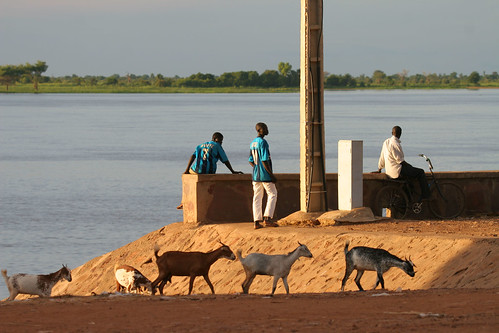
Fishermen and goats at the Niger River Fishermen and Sahelian goats by the Niger River, in Segou, Mali (photo credit: ILRI/Stevie Mann).

World Water Week in Stockholm is organized annually by the Stockholm International Water Institute and brings together experts from around the world to discuss pertinent issues around water and development.

At the start of this year’s World Water Week, taking place from 28 August to 2 September 2016, the University of Gothenburg, the Swedish International Agricultural Network Initiative, the Swedish University of Agricultural Sciences and the Swedish Ministry of Enterprise and Innovation convened a seminar on antimicrobial resistance and linkages between humans, livestock and water in peri-urban areas.

Among the speakers at the seminar was Delia Grace, a veterinary epidemiologist and food safety expert at the International Livestock Research Institute (ILRI). Her presentation was based on a report published in July 2016 by the Committee on World Food Security High-Level Panel…

View original post 94 more words

Posted in Poverty, Hunger, Malnutrition | Leave a comment

One million seedlings of economic trees, free to people in Sokoto (Nigeria)

Willem Van Cotthem's avatarDESERTIFICATION

Photo credit: The Union

Governor Tambuwal planting a tree to flag off this year’s tree planting campaign in Sokoto. Photo: Sokoto Govt House

Desertification: Sokoto To Plant 1m Trees

Governor Aminu Tambuwal of Sokoto State said, Tuesday, that the state government has raised no fewer than one million assorted seedlings of economic trees, to be distributed free to people in the state.

This, he said, is to mitigate the effect of desert encroachment threatening parts of the state.

Speaking at Bissalam village, Dange-Shuni Local Government of the state, at the launching of the 2016 Tree Planting Campaign Tuesday, Tambuwal said among the trees are moringa oleifera, baobab, mango, eucalyptus, cashew, neem, pawpaw and tamarind.

“These tree seedlings will be distributed free to the people in the 23 local governments across the state. Apart from serving some economic purposes, these trees will help in our re-afforestation efforts in the state.

“This…

View original post 106 more words

Posted in Poverty, Hunger, Malnutrition | Leave a comment

Assessing the Sustainability of Local and Global Food Chains – GLAMUR Special Issue

Dirk Roep's avatarRural Sociology Wageningen University

GLAMUR main messages

The EU-funded research project GLAMUR has been completed earlier this year. More info on the project, its sustainability performance-based approach and the findings can be accessed at the website. Next to all reports a synopsis of the project, its approach, the main findings and recommendations has been published, a leaflet with the main messages and finally a Special Issue of Sustainability: Sustainability Performance of Conventional and Alternative Food Chains was recently published containing eight open access articles following an editorial by Gianluca Brunori and Francesca Galli.

View original post

Posted in Poverty, Hunger, Malnutrition | 1 Comment

When will every school in developing countries have a school garden ?

Willem Van Cotthem's avatarDESERTIFICATION

Back to School: Local school gardens help kids

There are several school gardens in the Marathon County area and it could be helping your kids more than you think. The National Gardening Association found that school gardens will help students eat more fruits and vegetables and improve their social skills by working with others.

The Hatley Elementary School and Community Garden has expanded over past couple of years and more recently the school received a grant to purchase a green house helping kids like Caleb Breyton even more.

“I like to pull weeds and I like to pick the plants,” said Caleb Breyton in the garden.

The fifth grader works hard as he gets his knees and hands dirty while picking green beans and other veggies. Caleb not only likes to garden, but enjoys eating the growing plants too. Since being in the garden he says he has eaten more…

View original post 62 more words

Posted in Poverty, Hunger, Malnutrition | Leave a comment

Social Business: an opportunity to capture the benefits of multi-functional agriculture

GFAiR's avatarThe GFAiR Blog

An_ESAF_Sangam_Meeting_in_progress_in_Kerala

This article authored by Prof Muhammad Yunus, Nobel Peace Laureate 2006, was originally published on the World Farmers’ Organization (WFO) website and is featured in the August 2016 issue of their F@rmletter.

Rude Awakening

We are living in a time of unparalleled prosperity, fueled in part by revolutions in knowledge, science, and technology, particularly information technology. This prosperity has changed the lives of many, yet billions of people still suffer from poverty, hunger, and disease. And now, food, oil price and financial crises have combined forces to bring even greater misery and frustration to the world bottom 3 billion people.

Sadly, however, we saw headlines reporting news of a sort many people assumed we would never experience again: skyrocketing prices for staple foodstuffs like grains and vegetables (wheat alone having risen in price by 200 percent since the year 2000); food shortages in many countries; rising rates of death…

View original post 1,740 more words

Posted in Poverty, Hunger, Malnutrition | Leave a comment

Six TEDx talks on food security

canwefeedtheworld's avatarOne Billion Hungry: Can We Feed the World?

TEDxWhile we spend a lot of our time with our noses stuck in books, reports and articles we also like to hear from global experts from time to time. Here are 6 of our favourite TED talks.

ellenEllen Gustafson: Co-creator of the philanthropic FEED bags, Ellen Gustafson says hunger and obesity are two sides of the same coin. In her talk, she launches The 30 Project — a way to change how we farm and eat in the next 30 years, and solve the global food inequalities behind both epidemics.  Watch the video

tristanTristram Stuart: Western countries throw out nearly half of their food, not because it’s inedible — but because it doesn’t look appealing. Tristram Stuart delves into the shocking data of wasted food, calling for a more responsible use of global resources.  Watch the video

jon foleyJonathan Foley: A skyrocketing demand for food means that agriculture…

View original post 229 more words

Posted in Poverty, Hunger, Malnutrition | Leave a comment

Apocalyptic numbers: Antibiotic resistance as the classic ‘One Health’ (and classic ‘One World’) planetary issue

Susan MacMillan's avatarILRI news

BlakeWilliam_Urizen

Depicted in this watercoloured etching, The Ancient of Days, by William Blake,
is Urizen, a  figure that for Blake embodied reason and law.
Urizen’s outstretched hand holds a compass over the darker void below,
representing an event in the Book of Proverbs,
‘when he set a compass upon the face of the earth’
(image via the British Museum).

This is the first in a series of articles being published by the International Livestock Research Institute (ILRI) in the lead up to the High-Level Meeting on Antimicrobial Resistance, which will be held in the margins of the 71st session of the United Nations General Assembly, attended by heads of state and government at the UN’s New York City headquarters on 21 Sep 2016. Global leaders at the summit will commit to leading the fight against antimicrobial resistance, including the all-important resistance to antibiotics. Following statements from the World Health Organisation…

View original post 2,027 more words

Posted in Poverty, Hunger, Malnutrition | Leave a comment

The Best Option for Sustainable Food Production in Challenging Environment ~is the Promising Camel

Posted in Poverty, Hunger, Malnutrition | Leave a comment

Saudi livestock market requirements, implications for Somaliland

James Stapleton's avatarILRI Clippings

Cattle in quarantine awaiting export to Middle East from Berbera port, Somaliland Cattle for export to Middle East from Somaliland (photo credit: ILRI/Peter Ballantyne).

Livestock are the backbone of the Somaliland economy. Livestock production accounts for about 60% of the country’s gross domestic product, 70% of employment opportunities and 85% of export earnings, and about 15% of total government revenue. Despite being Somaliland’s biggest livestock export market, little is known about marketing channels, grading and pricing of Somaliland livestock in Saudi Arabia. A recent research report, ‘Saudi Arabia end-market requirements and the implications for Somaliland livestock exports’, sheds a light on these key issues and how they affect Somaliland exporters.

The report found two main trading channels: the sacrificial value chain and the commercial value chain. The sacrificial value chain is active during the lunar months associated with Hajj and Umra pilgrim movements and other religious occasions when livestock demand is high, while the commercial value chain is dominant during the lunar months of Muharram to

View original post 530 more words

Posted in Poverty, Hunger, Malnutrition | Leave a comment

Africa’s indigenous land grabs—African middle-aged public-sector urbanites in rush to buy farmland

Susan MacMillan's avatarILRI Clippings

Charles Murithi_KS_Farmer

Charles Murithi, Kenyan farmer (photo credit: BurnessGlobal/Jeff Haskins).

For middle-class Tanzanians . . . a successful farmer trumps a successful academic. . . . [A] quiet, hard-to-track but momentous change [is happening] in Africa, which has profound consequences for the continent’s most important industry.

‘[I]n Kenya, Malawi and Zambia (though not in Ghana) most medium-sized farms were not built by successful smallholders but bought by urbanites. In Tanzania, where about one-third of the population is urban, city-dwellers are thought to own 33% of the farmland, up from just 12% a decade ago. Typically, the new farmers are middle-aged public-sector workers.

The popular obsession with foreign land grabs is wrong-headed, says Isaac Minde of Sokoine University of Agriculture in Morogoro. If there is a land grab in Africa, it is being done by African urbanites.

‘City-dwellers are going into farming partly because legal reforms have made buying land easier and ownership…

View original post 201 more words

Posted in Uncategorized | Leave a comment

EU, US and UN Call on the International Community to Scale Up Emergency Response in the Lake Chad

APO's avatarDatabase of Press Releases related to Africa - APO-Source

At the end of a visit to the Lake Chad Basin countries of Cameroon, Chad and Niger, Assistant Secretary of State for Population, Refugees and Migration of the US Department of State, Ms. Anne Richard, and EU Commissioner for Humanitarian Aid and Crisis Management, Mr. Christos Stylianides, as well as UN Assistant Secretary-General Toby Lanzer, called on the international donor community to increase… Read more on http://africa-newsroom.com/press/eu-us-and-un-call-on-the-international-community-to-scale-up-emergency-response-in-the-lake-chad?lang=en

View original post

Posted in Uncategorized | Leave a comment

Jimmy Smith’s address to UK parliamentary group on the potential of livestock for development

Susan MacMillan's avatarILRI news

Jimmy Smith presents on livestock to UK parliament

‘Animal agriculture is the Cinderella of the agricultural world’,
Jimmy Smith tells the UK All-Party Parliamentary Group
on Agriculture and Food for Development.

Presentation to the UK All-Party Parliamentary Group

on Agriculture and Food for Development

The role of livestock in smallholder livelihoods

29 June 2016

by Jimmy Smith, director general of the International Livestock Research Institute

Livestock can play major roles in development. Today I’m going to talk about the diversity of the livestock sector—and the many diverse ways that livestock contribute to economic growth and poverty reduction, to food and nutritional security and to sustainable food production.

Of course, mention of the ‘livestock sector’ conjures up greatly diverse images. The intensive livestock production systems common in rich countries—with sheds housing thousands of broiler chickens, or feedlots of beef cattle, or air-conditioned pig units, or high-tech dairy milking parlours—contrast sharply with the practices of small-scale farmers raising a couple…

View original post 2,956 more words

Posted in Uncategorized | Leave a comment

New approaches to agricultural productivity to alleviate poverty, malnutrition and hunger (AlertNet)

Willem Van Cotthem's avatarDESERTIFICATION

Read at :

http://www.trust.org/alertnet/news/revamp-african-ag-policy-to-address-hunger-and-poverty-experts/

Revamp African ag policy to address hunger and poverty – experts

Source: alertnet // Katie Murray

By Katie Murray

LONDON (AlertNet) – New approaches to agricultural productivity could help alleviate widespread poverty, malnutrition and hunger in many African countries, international development and agriculture experts said at a conference this week in Ethiopia focused on boosting agricultural output in Africa.

In 2003, African heads of state agreed to allocate 10 percent of their national budget to agriculture and rural development policy within five years.  That target was not reached, but as a whole African countries have since managed to double their spending on agricultural and rural policy from an average of 3 percent to 6 percent of national spending, said Shenggen Fan, the director of the International Food Policy Research Institute, an organization that works to find sustainable solutions to ending poverty and hunger.

The problem is…

View original post 151 more words

Posted in Uncategorized | Leave a comment

The Africa Union’s Malabo Declaration and climate change

Willem Van Cotthem's avatarDESERTIFICATION

Photo credit: SciDevNet

Copyright: Anna-Marie Ball/IFPRI

African policy to end hunger silent on climate risk

by Baraka Rateng’

Speed read

  • The Africa Union’s Malabo Declaration aims to end hunger by 2025
  • A new report says it does not pay attention the risks of climate change
  • Experts call for African nations to invest in climate risks knowledge creation

The African Union’s Malabo Declaration adopted in 2014 to double agricultural productivity and end hunger by 2025 underestimated the risk that climate change will pose, a report says.

The declaration failed to consider investing in Africa’s scientific capacity to combat climate threats, according to the report, which was produced by the UK-based Agriculture for Impact, and launched in Rwanda this month (14 June).

“Food security and agricultural development policies in Africa will fail if they are not climate-smart”, says Gordon Conway, director of Agriculture for Impact and chair of the Montpellier Panel, which is…

View original post 135 more words

Posted in Uncategorized | Leave a comment

Next Brussels Briefing 45: “Affordable smart farming solutions for Africa: the next driver for African agriculture”

ctabrussels's avatarBrussels Development Briefings

The Brussels Development Briefing n.45 on the subject of “Affordable smart farming solutions for Africa: the next driver for African agriculture” will be  held in Brussels at 09:00-13:00 on 13th July 2016 at the Albert Borschette Congress Center, Room 1.A (Rue Froissart 36, 1040 Brussels).  This Briefing is being organised by the ACP-EU Technical Centre for Agricultural and Rural Cooperation (CTA), in collaboration with the European Commission, the the European Commission / DEVCO, the ACP Secretariat, CONCORD, CEMA, Agricord and the PanAfrican Farmer’s Organisation (PAFO).

 Advance REGISTRATION is required in order to attend this event. Click here to register for this Briefing.

***

Programme and Background Note

Reader (available soon)

Highlights (available soon)

Photos (available soon)

Biodata of the speakers (available soon)

Resources (available soon)

View original post

Posted in Uncategorized | Leave a comment

#Farming Friday 48: So You Want To Be A Farmer?

Thought+Food's avatarThought + Food

ID-1001128 (1)

Today was a perfect early summer day: gorgeous sunshine, with a breeze to lighten the warmth. The sort of day when, driving past a farm on a quiet road; or heaping up your baskets with berries or summer squash at a pick-your-own farm; or, even watching a baby goat video your friend shared, you might say: “One day I am going to have my own farm.” And you would not be alone. There is a renewed interest in farming amidst the ongoing noisy debate on food issues.

But what is life on a farm really like? Like the pretty pictures on Instagram or Pinterest? Sometimes, yes. But what is often not visible is the sheer hard labor, the exhaustion of caring for animals, the regulations and paperwork that need to be followed and the overwhelming amounts of poop!

Still interested in following the farm dream? Here is an inside look…

View original post 28 more words

Posted in Uncategorized | Leave a comment

How agriculture changes our climate—New primer from Minnesota’s Institute on the Environment

Susan MacMillan's avatarILRI Clippings

16UnivMinnesota_EnvironmentReports_FoodMatters_HowDoesAgricultureChangeOurClimate_ShareOfGlobalEmissionsGraphic

Share of global greenhouse gas emissions (University of Minnesota’s Institute on the Environment, 2016).

The following is an unusually sane and well communicated multimedia primer on the sustainability of the global food system. Food Matters, republished here in full with permission, is published by the Institute on the Environment at the University of Minnesota. It is the first in a series of Environment Reports and is a collaboration between an international group of scientists, writers, and designers to combine incisive narratives about environmental challenges, backed up by cutting-edge data. Funding for this project was largely provided by a grant from the Mosaic Company, with additional funding for research and analysis provided by the Gordon and Betty Moore Foundation. Do check out the full multimedia version, which has sources, links, images, more interactive graphics and other materials missing here. Enjoy!

Agriculture, deforestation and other land use
account for roughly 20…

View original post 1,304 more words

Posted in Uncategorized | Leave a comment

INVESTMENT IN AGRICULTURE TO FEED GROWING WORLD POPULATION (UNNews / FAO)

Willem Van Cotthem's avatarDESERTIFICATION

Read at : UNNews

UN AGENCY URGES INVESTMENT IN AGRICULTURE TO FEED GROWING WORLD POPULATION

New York, Sep 23 2009 12:05PM

Farmers need to increase global food production by some 70 per cent in the coming decades to feed an additional 2.3 billion people by 2050, warned a paper published by the United Nations food agency today, which calls for urgent investment in agriculture.

With the world population expected to balloon by one-third to 9.1 billion people, the Food and Agriculture Organization (<“http://www.fao.org/”>FAO) underscored the importance of using scarce natural resources more efficiently and investing in agriculture to combat a deepening hunger and poverty crisis.

The FAO is slated to organize a high-level expert forum next month in Rome to explore strategies on “How to Feed the World in 2050,” which is aimed at preparing the ground work for the World Summit on Food Security in November.

“FAO is cautiously…

View original post 344 more words

Posted in Uncategorized | Leave a comment

If the world’s experts are wrong, who are the real experts being right ? (Foreign Policy)

Willem Van Cotthem's avatarDESERTIFICATION

Read at :

http://www.foreignpolicy.com/articles/2011/05/04/can_the_world_feed_10_billion_people?page=0%2C0

Can the World Feed 10 Billion People?

With an exploding global population — and Africa’s numbers set to triple — the world’s experts are falling over themselves arguing how to feed the masses. Why do they have it so wrong?

BY RAJ PATEL

The world’s demographers this week increased their estimates of the world’s population through the coming century. We are now on track to hit 10 billion people by 2100. Today, humanity produces enough food to feed everyone but, because of the way we distribute it, there are still a billion hungry. One doesn’t need to be a frothing Malthusian to worry about how we’ll all get to eat tomorrow. Current predictions place most of the world’s people in Asia, the highest levels of consumption in Europe and North America, and the highest population growth rates in Africa — where the population could triple

View original post 279 more words

Posted in Uncategorized | Leave a comment

African countries will need to spend more of their budgets on developing their agricultural sector (Find Your Feet)

Willem Van Cotthem's avatarDESERTIFICATION

Read at :

http://findyourfeet.wordpress.com/2010/06/28/africa-is-not-spending-enough-on-food/?utm_source=feedburner&utm_medium=feed&utm_campaign=Feed%3A+FindYourFeetsBlog+%28Find+Your+Feet%27s+Blog%29

Africa is not spending enough on food

This piece was posted by Hilde Faugli, Communications Intern at Find Your Feet.

70 percent of people in Africa live in rural areas and depend on agriculture for food and income

While most talk about Africa these days centers on the World Cup in South Africa, sobering facts about the continent’s food situation have been presented in an International Food Policy Institute (IFPRI) paper entitled Public Spending for Agriculture in Africa: Trends and Composition. According to the paper insufficient spending on agriculture Africa means that the continent is “now facing the same type of long-term food deficit problem that India faced in the early 1960s.

70 percent of people in Africa live in rural areas and depend on agriculture for food and income. Spending money on food production is therefore critical. Regrettably, only eight African countries have reached the…

View original post 278 more words

Posted in Uncategorized | Leave a comment

Africa is not spending enough on food (Find your feet)

Willem Van Cotthem's avatarDESERTIFICATION

Read at :

http://findyourfeet.wordpress.com/

Africa is not spending enough on food

This piece was posted by Hilde Faugli, Communications Intern at Find Your Feet.

While most talk about Africa these days centers on the World Cup in South Africa, sobering facts about the continent’s food situation have been presented in an International Food Policy Institute (IFPRI) paper entitled Public Spending for Agriculture in Africa: Trends and Composition. According to the paper insufficient spending on agriculture Africa means that the continent is “now facing the same type of long-term food deficit problem that India faced in the early 1960s.

70 percent of people in Africa live in rural areas and depend on agriculture for food and income. Spending money on food production is therefore critical. Regrettably, only eight African countries have reached the target adopted by the Comprehensive Africa Agriculture Development Programme (CAADP) in 2003. Back then, the continent committed to allocating…

View original post 230 more words

Posted in Uncategorized | Leave a comment

Tackling food emergencies in Africa (id21)

Willem Van Cotthem's avatarDESERTIFICATION

Read at :

id21 (see my Blogroll)

http://www.id21.org/society/s2rm1g1.html

The average number of food emergencies in Africa has almost tripled since the 1980s. Today, approximately one third of people in sub-Saharan Africa are undernourished. Although the money spent on short-term food aid has increased, aid for increasing agricultural production – essential for long-term food security – has decreased. A report from Oxfam, an international non-governmental organisation, found that many problems remain unresolved since their first campaign to find solutions to food crises in 1960. People are extraordinarily resourceful during acute food crises. However, when local survival strategies are exhausted, and when national governments are unwilling or unable to act, international humanitarian assistance becomes vital.

View original post 584 more words

Posted in Uncategorized | Leave a comment

FUNDING GAP THREATENS EFFORTS TO ASSIST MILLIONS FACING HUNGER IN AFRICA – UN OFFICIAL (UN News)

Willem Van Cotthem's avatarDESERTIFICATION

New York, May 10 2012  1:05PM

A major funding gap is threatening efforts to boost food security and development in the Sahel region of West Africa and in the Horn of Africa in the east, a senior United Nations official warned today.

The Horn of Africa, which includes countries such as Somalia and Djibouti, experienced a food crisis last year that left an estimated 13 million people dependent on humanitarian assistance. Currently there are 15 million people facing food insecurity in the Sahel, which stretches from the Atlantic Ocean to the Red Sea, and includes countries such as Niger and Mali.

“In the Horn of Africa we are losing the window of opportunity to build on our recent achievements – which helped to overcome the famine declared last year in Somalia – increasing the resilience of families facing drought,” <“http://www.fao.org/news/story/en/item/142504/icode/”>said the Director-General of the Food and Agriculture Organization (FAO), José…

View original post 258 more words

Posted in Uncategorized | Leave a comment

LARGEST DATABASE OF HUNGER STATISTICS (UNNews)

Willem Van Cotthem's avatarDESERTIFICATION

Read at : UNNews

UN AGENCY OPENS UP ACCESS TO LARGEST DATABASE OF HUNGER STATISTICS

New York, Jul 9 2010 1:05PM

The world’s largest and most comprehensive database on food, agriculture and hunger is now open to the public, free of charge, the United Nations Food and Agriculture Organization (<“http://www.fao.org/”>FAO) announced today.

Previously, it was possible to download a limited amount of information from <“http://faostat.fao.org/”>FAOSTAT, but access to large amounts of data required a paid annual subscription.

The database contains over one million data points covering more than 200 countries and territories.

View original post 183 more words

Posted in Uncategorized | Leave a comment

Rural, food and agricultural cooperatives and producer organizations to eliminate hunger and reduce poverty (UN News / FAO)

Willem Van Cotthem's avatarDESERTIFICATION

Read at :

COOPERATIVES CENTRAL TO FIGHTING HUNGER, STRESSES UN AGENCY

New York, Jan 24 2012  6:05PM

Cooperatives and producer organizations will be increasingly important in efforts to eliminate hunger and reduce poverty, the head of the United Nations Food and Agriculture Organization (FAO) said today.

“FAO needs strong cooperatives and producer organizations as key partners in the effort to eliminate hunger for some 925 million people, and to respond to the many challenges that face our world today,” <“http://www.fao.org/news/story/en/item/120774/icode/”>said Director-General José Graziano da Silva.

He told participants at the 2012 Thematic Social Forum in Porto Alegre, Brazil, that FAO would be stepping up its collaboration with producer organizations and rural, food and agricultural cooperatives that give organizational, economic, and social clout to small farmers, pastoralists and those who rely on fishing and forestry for their livelihoods.

“FAO is committed to seeking out and sharing evidence of the impact of…

View original post 221 more words

Posted in Uncategorized | Leave a comment

‘Africa rising’–Bill Gates on what’s working in health and agriculture

Susan MacMillan's avatarILRI Clippings

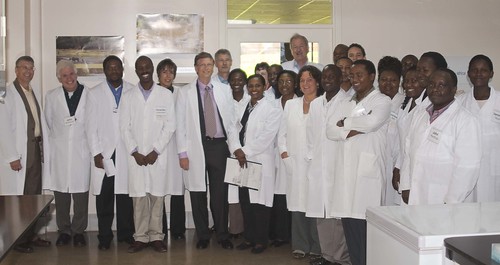
Bill Gates visits the BecA Hub at ILRI in December 2009

Bill Gates made a private visit to the Biosciences eastern and central Africa Hub (BecA Hub), hosted and managed by the International Livestock Research Institute (ILRI), in Nairobi, Kenya, in early December 2009, and toured the new and refurbished labs (photo credit: ILRI/Ouma).

Bill Gates writes in his third annual letter that he sees ‘Africa on the rise’. About agriculture, he says that: ‘When farmers increase their productivity, nutrition is improved and hunger and poverty are reduced.’

‘Agriculture’s Great Promise

‘Outside of health the area where we invest the most to help poor people is agriculture. There is so much potential in agricultural development because most poor people in the world feed their families and earn their income from farming. When farmers increase their productivity, nutrition is improved and hunger and poverty are reduced. In countries like Rwanda, Ethiopia, and Tanzania, investments in seeds, training, access to markets, and innovative…

View original post 634 more words

Posted in Uncategorized | Leave a comment

Why Melinda and Bill Gates are betting big on chickens (hint: ‘the ATM of the poor’)

“Many men think chickens aren’t worth their time because the income from them is small and sporadic. So women fill the gap.”

Susan MacMillan's avatarILRI Clippings

Chicken_AsafoFlag_Detail

Asafo Flag detail, Fante people, Ghana.

From Melinda Gates
‘Chickens in America have it rough . . . the symbol of cowards. . . the butt of corny cross-the-road jokes. . . .

‘But if you ask a woman in a developing country about chickens, she’s likely to show a lot more respect. That’s because a chicken can mean the difference between a family that merely survives and one that thrives.

‘For one thing, chickens are a good source of income. In fact, chickens are known in international development circles as “the ATM of the poor,” because they are easy to sell on short notice to cover day-to-day expenses.

‘Furthermore, eating chickens (and eggs) is good for you. In fact, they contain seven essential micronutrients like calcium and vitamin A.

Woodcut by Walter Williams.

‘But there’s another, less intuitive way that chickens make life much better for poor people.

‘In…

View original post 561 more words

Posted in Uncategorized | Leave a comment

Livestock for better nutrition and disease control–One Health Colloquium held this week at Chatham House

Susan MacMillan's avatarILRI news

ChickenPigCow_BurgundyBackground

Stacked farm animal figurine (from zulily on Pinterest).

One Health Colloquium
Sustainable Livestock, Disease Control,
Climate Change and the Refugee Crisis

31 May–1 Jun 2016
Chatham House, London

The Centre on Global Health Security at Chatham House, London—which examines how global health challenges manifest themselves in foreign policy and international affairs—is looking at links between sustainable livestock systems and livestock disease control on the one hand and climate change, human nutrition and today’s refugee crisis on the other.

Today and tomorrow (31 May–1 Jun 2016), Chatham House, the Livestock Global Alliance (LGA), the One Health Platform and other One Health partners are convening senior policymakers, academics, multilateral development agencies, business leaders and other private-sector stakeholders to discuss these topics. Outcomes of the discussions will feed into a series of policy recommendations for multilateral agencies, opportunities for collaboration between the public and private sectors, and a research agenda for…

View original post 1,333 more words

Posted in Uncategorized | 1 Comment

Supporting the world’s smallholder livestock keepers can increase food supplies while reducing absolute poverty

Susan MacMillan's avatarILRI Clippings

EADD Annual Review and Planning Meeting 2011

A young boy in Kenya feeds his family’s improved dairy cows (photo credit: East Africa Dairy Development project).

‘The head of the global livestock research centre (ILRI) in Kenya says smallholder farmers will be essential in providing the animal protein needed to feed nine billion people by 2050.

‘Dr Jimmy Smith’s comments are in response to calls for people to go vegan to reduce greenhouse gas emissions and the impact of grazing.

. . . [E]cosystems are under pressure as farmers try to produce one billion tonnes more dairy and [460] million tonnes more of meat [each year] within four decades — Jimmy Smith

‘He told the International Grasslands Congress in Sydney that the reality is that 1.3 billion people work in the livestock sector, and livestock grazing covers one third of the earth’s ecosystems. . . .

“[T]he food equation cannot be met without Australia and New Zealand, who produce…

View original post 44 more words

Posted in Uncategorized | Leave a comment