Africa’s potential for intensifying production by practising ‘ecological agriculture’ (New Agriculturist)

Willem Van Cotthem's avatarDESERTIFICATION

Read at :

http://www.new-ag.info/en/book/review.php?a=2149

Climate change and food systems resilience in Sub-Saharan Africa

Edited by Lim Li Ching, Sue Edwards and Nadia El-Hage Scialabba
Published by FAO
Website: Earthprint (to purchase this book) or FAO website (to download a free copy)
2011, 448pp, ISBN 978 9 251068 762

To meet the demands of a growing population, global food production must increase. Climate change and food systems resilience in Sub-Saharan Africa outlines Africa’s potential for intensifying production by practising ‘ecological agriculture’.

In Tigray, Ethiopia, crop yields have almost doubled using ecological practices, including composting, soil conservation, agroforestry and crop diversification. “Ecological agriculture holds significant promise for increasing the productivity of Africa’s smallholder farmers, with consequent positive impacts on food security,” the authors state.

Degraded soils and increasingly unreliable rainfall constrain agricultural production in many developing countries. Governments have responded by encouraging the use of chemical fertilisers but, due to escalating prices…

View original post 15 more words

Posted in Poverty, Hunger, Malnutrition | Leave a comment

In 2050, Africa will scarcely be able to grow enough food for its own population.

Willem Van Cotthem's avatarDESERTIFICATION

Can Africa feed itself?

https://www.sciencedaily.com/releases/2016/12/161213074109.htm

Date:
December 13, 2016
Source:
Wageningen University & Research
Summary:
In 2050, when the population of Africa is two and a half times larger than now, the continent will scarcely be able to grow enough food for its own population. Even if much higher yields are achieved on all current cropland, further expansion into uncultivated areas is likely and very risky due to biodiversity loss and increased greenhouse gas emissions.

In 2050, when the population of Africa is two and a half times larger than now, the continent will scarcely be able to grow enough food for its own population. Even if much higher yields are achieved on all current cropland, further expansion into uncultivated areas is likely and very risky due to biodiversity loss and increased greenhouse gas emissions. Based on local data and model calculations, this was the conclusion of a study conducted…

View original post 29 more words

Posted in Poverty, Hunger, Malnutrition | Leave a comment

Food security: A Unique Urban Garden

Willem Van Cotthem's avatarDESERTIFICATION

Photo credit: Balcony Garden Web

Vegetables that are productive, for example, beans, tomatoes, peppers, etc. are the most suitable for urban gardeners. Other vegetables like spinach, lettuce, carrots take less space and productive too, this way you can grow more plants and have abundant harvest. To help you, we already published a list of the most productive container vegetables, must take a look!

How To Start A Unique Urban Garden To Grow Lots Of Plants In So Less Space

To start an urban garden, you need the right tools, ideas, and some inspiration. This post is all about that!

Do you want to start a small urban garden? Do you have enough space for planting? What if the landlord doesn’t want to have a garden in the compound? Some things like space and time should not stop you from starting a garden.

Read the full article: Balcony Garden Web

View original post

Posted in Poverty, Hunger, Malnutrition | Leave a comment

Improved varieties of groundnut for processing that offer at least twice the potential quantities of oil for extraction.

Willem Van Cotthem's avatarDESERTIFICATION

Photo credit: ICRISAT

Women at the groundnut processing center. Photo: WOFAN

GROUNDNUT VARIETIES WITH HIGHER OIL CONTENT EMPOWERING WOMEN IN NIGERIA

Using improved varieties of groundnut for processing that offer at least twice the potential quantities of oil for extraction in comparison to local varieties is helping to economically empower women in Nigeria. Women Farmers Advancement Network (WOFAN) and ICRISAT are working to promote improved groundnut production technologies for the Yadakwari community in Garun Mallam Local Government Area (LGA) of Nigeria.

The Yadakwari Women’s Community Service Centre is now using these improved varieties to produce more groundnut oil (up to 350 liters per week) in addition to kuli-kuli (a popular local groundnut-based snack; see box). The demand for locally pressed groundnut oil and kuli-kuli is so high that they are being immediately sold in the local markets.

“Improved varieties of groundnut from ICRISAT have brought happiness to many farm-families in…

View original post 60 more words

Posted in Poverty, Hunger, Malnutrition | Leave a comment

Can smallholder farmers take a leading role in addressing the twin challenges of food security and environmental sustainability?

Paul Karaimu's avatarILRI Clippings

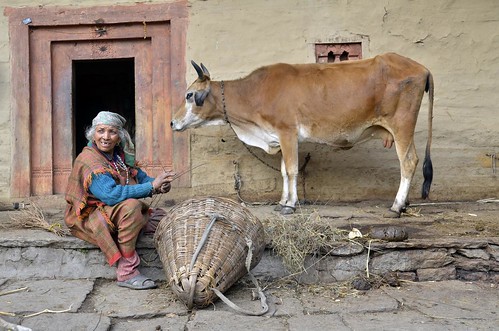
NP Himachal Pradesh 75

A farmer in Himachal Pradesh, India. Smallholder farmers can contribute to the search for climate solutions (photo credit: Neil Palmer/CIAT).

Paul Kagame, the president of the Republic of Rwanda, says experience from that country shows that smallholder farmers can contribute to the search for climate-smart solutions and climate talks should bring smallholder agriculture into the discussion.

In an opinion piece published in Business Daily (Kenya), he says:

‘Until the world’s small farmers adopt a series of necessary changes, climate talks such as the United Nations Rio+20 Summit, which will take place in Rio de Janeiro this June, will never translate into action.’

‘The emergence of a global green economy requires governments, other policymakers, and businesses from developed and emerging economies to recognize the inextricable linkages between climate change, the environment, and food security. This means bringing the world’s smallholder agriculture into the discussion.’

‘Every day, smallholder farmers in developing countries…

View original post 135 more words

Posted in Poverty, Hunger, Malnutrition | Leave a comment

First map of smallholder farms in the developing world: They produce more than half the planet’s food calories

Susan MacMillan's avatarILRI Clippings

16univofminnesota_mapofmeanagriculturalarea

Role of MAA classifications in regional production. (a) Percentage of food calories produced in each of three regions originating in units classified by MAA. Includes calories delivered from 41 major crops into the food system, as per Cassidy et al. (b) Mean cattle density by unit farm size classification in each of three regions, drawn from Robinson et al. Error bars represent standard error of the mean. (Map by the study’s co-authors.)

‘Researchers at the University of Minnesota Institute on the Environment (IonE), United States, have used household census data to map smallholder farms in developing countries.

‘Despite the fact that smallholder and family farms are crucial to feeding the planet, little is known regarding the location and size of smallholder farms. This study attempts to fill this knowledge gap.

‘The study was published in the journal Environmental Research Letters.

Read the whole article at the University of Minnesota…

View original post 1,709 more words

Posted in Poverty, Hunger, Malnutrition | Leave a comment

WhatsApp for Agriculture: Digital Farming highlights the need for Digital Agriculture Extension

GFAiR's avatarThe GFAiR Blog

ubuhinzi-bwacu-snap-002

I remember one time I was asked to walk 10 kilometers away from home to find a local buyer to sell our marakuja and papaya fruit so that my parents could pay my school fees. This buyer in turn walked 10 kilometers to sell the fruit in Kigali, Rwanda’s capital. There were no mobile phones to call each other; there was no other option but to walk these distances. In our village if anyone needed to use pesticide in their coffee plantation, they had to go house-by-house to find a pumping machine. As you can imagine, it would take a long time to ask the whole village.

Nowadays, I feel blessed that I can automatically open my smartphone to check new messages and chat with a group of young farmers on WhatsApp. Actually, these farmers are what I call “the hope for tomorrow.” When I access the WhatsApp group, I can…

View original post 820 more words

Posted in Poverty, Hunger, Malnutrition | Leave a comment

Youth Network in Agriculture: we connect and rejuvenate the world

GFAiR's avatarThe GFAiR Blog

23160179004_d87330d675_oAt the occasion of YPARD 10 years, Marina Cherbonnier, the current communications and knowledge manager, expresses what the added value of YPARD is, as an international network of young professionals in agriculture.

I was 25 when I joined YPARD’s global coordination unit as the first web and communications officer. We were two employees then. In retrospect, I feel I grew up as an adult at a faster pace with YPARD, because, to a large extent, I had to take care of and be responsible for our youth community.

I had never understood how central my role could look like because, to me, YPARD was – and is – all the members that are joining, one by one, the community. I still remember my interviews for the position; I had one word in mind: ownership. It is only some months ago that the concept was brilliantly challenged by one of…

View original post 1,332 more words

Posted in Poverty, Hunger, Malnutrition | Leave a comment

One in three people suffers some form of malnutrition – Enormous economic burden

Willem Van Cotthem's avatarDESERTIFICATION

Photo credit: FAO

A farming family in Kyrgyzstan takes a break from the day’s work to share a meal.

Malnutrition in the crosshairs

One in three people suffers some form of malnutrition – Enormous economic burden – International meeting searches for ways to improve diets and food systems

Responding to the mounting impacts of malnutrition on public health and economic development — estimated to cost $3.5 trillion per year — via a shift to healthier diets and food systems will be the subject of a high-level symposium kicking off here today.

The International Symposium on Sustainable Food Systems for Healthy Diets and Improved Nutrition (1-2 December) will look at country-level challenges and successes to shed light on effective approaches to reshaping food production, processing, marketing and retail systems to better tackle the problem of malnutrition, which blights the lives of billions of individuals and can trap generations in a vicious cycle…

View original post 162 more words

Posted in Poverty, Hunger, Malnutrition | Leave a comment

To target 10 million farmers practicing climate-smart agriculture in the next five to seven years.

Willem Van Cotthem's avatarDESERTIFICATION

Photo credit: CIMMYT

A new stress-tolerant maize variety compared in Zimbabwe. CIMMYT/Johnson Siamachira

Target for 10 million more climate-smart farmers in southern Africa amid rising cost of El Niño

El Niño may have passed, but food security in southern Africa will continue to deteriorate until next year, as farmers struggle to find the resources to rebuild their livelihoods. Currently, around 30 million people in southern Africa require food aid, expected to rise to 50 million people by the end of February 2017.

Two Zimbabwe-based scientists from the International Maize and Wheat Improvement Center (CIMMYT) highlighted predictions that El Niño will become more frequent and severe under climate change, and that heat stress will reduce maize yields in southern Africa by 2050. Research centers, development agencies and governments must work together to respond to climate predictions before food crises develop, they said.

sam-drought-southern-africa-2015-2016-1-300x258 Drought in southern Africa during El…

View original post 123 more words

Posted in Poverty, Hunger, Malnutrition | Leave a comment

Squaring the Universality of Human Rights and Hunger with Delegate Representation at the CFS

FoodGovernance's avatarFood Governance

By Nadia Lambek

This entry is part of a special series of blog posts about the UN’s Committee on World Food Security (CFS): The Future of the CFS? Collectively reflecting on the directions of UN’s most inclusive body. Read more about this project here.

This week we inaugurate the thematic cluster CFS, a rights-oriented body? Nadia Lambek’s provocative entry discusses universality – a key principle of international human-rights body and other global processes, such as 2030 Agenda for Sustainable Development. The North-South divide found at CFS representation carriers important implications for the effectiveness and legitimacy of the Committee, she argues.

This is not an exclusive project. If you would like to participate, please let us know: foodsecuresolutions@gmail.com

At the opening session of the 43rd CFS, in a room crowded with representatives of ministries of agriculture, food and livestock, the United States representative to the CFS made her…

View original post 879 more words

Posted in Poverty, Hunger, Malnutrition | Leave a comment

The Effect of Producer Organizations on Farmer Performance

GFAiR's avatarThe GFAiR Blog

img_4347 Focus group led by COSA research partners in October 2015 with members of one of the producer organizations involved in the Kenya impact evaluation

Over the years, the Committee on Sustainable Assessment (COSA) has conducted dozens of experimental and quasi-experiment impact assessments in countries around the world.  COSA employs the most rigorous methodologies available to better understand the social, economic and environmental impacts of agriculture in the belief that credible evidence of what works and what does not will lead to more sustainable practices.  One of the ways that COSA pursues its goals is by conducting statistically significant surveys informed by detailed qualitative research that starts with development of a theory of change and is validated through wide-ranging stakeholder interviews.

We aimed to find out if Producer Organization (PO) management truly affects farmer performance in the way that typical theories of change hypothesize.1 Producer organizations, according to the FAO…

View original post 613 more words

Posted in Poverty, Hunger, Malnutrition | Leave a comment

Transforming cassava peel waste to quality feeds fast-tracked by private sector in Nigeria

ILRI Communications's avatarCGIAR Research Program on Livestock and Fish

The International Livestock Research Institute (ILRI) in Ibadan, Nigeria, recently developed a technology to process fresh cassava peels into high quality cassava peel products with better shelf life and nutrient profiles acceptable to the feed industry.

The activity is an outcome of a multi-centre CGIAR collaboration including ILRI, the International Institute of Tropical Agriculture (IITA) and the International Potato Center (CIP) and several CGIAR research programs: Roots, Tubers and Banana, Humidtropics and Livestock and Fish.

The three critical stages of successful technology generation – technology development and refinement, technology pilot testing and validation and finally technology commercialization for the cassava peel processing technology began in late 2014. Through this technology around 50 million tons of peels that are currently being wasted each year and treated as environmental nuisance will become a tradable livestock feed commodity. It has the potential to add around 15 million tons of quality feed creating a…

View original post 524 more words

Posted in Poverty, Hunger, Malnutrition | Leave a comment

Innovations Vital for Food Security (Truth about Trade and Technology)

Willem Van Cotthem's avatarDESERTIFICATION

Read at :

http://www.truthabouttrade.org/news/latest-news/16333-innovations-vital-for-food-security

Innovations Vital for Food Security

The African Executive
July 21-28, 2010
http://www.africanexecutive.com

Agricultural innovations are still relevant in transforming livelihoods in Africa, a stakeholder lecture on “Food and Culture” has heard.

Using a case study of the cassava revolution in Africa, researchers estimate that resource-poor farmers in Nigeria, alone, traded improved cassava stems—a part that is often neglected for having commercial value—worth more than US$1 million (about N150m) in five years. Professor Lateef Sanni, IITA Scientist, says that this increase in incomes of farmers came between 2003 and 2008.

Organized by the Public Affairs Section of the United States Consulate General, Lagos and IITA in Ibadan; the “Food and Culture” lecture brought together experts in the food and agricultural sector including a guest lecturer from Tufts University. Stakeholders reviewed the US agricultural experience and brainstormed on areas that Africa could tap into.

In his presentation titled:…

View original post 113 more words

Posted in Poverty, Hunger, Malnutrition | Leave a comment

Repositioning policies to reflect agriculture as the new engine for growth

Willem Van Cotthem's avatarDESERTIFICATION

Photo credit: SciDevNet

Copyright: Flickr/IITA

Could systems research transform Africa’s agriculture?

by Alex ABUTU

I know across Africa, presidents are repositioning their policies to reflect agriculture as the new engine for growth, and are also changing strategies that considered agriculture as a social obligation to a business enterprise.

In Nigeria, for instance, the president launched the green alternative with an agricultural transformation agenda to show how important the administration prioritises agriculture.

But scientists and researchers at a three-day workshop at the International Institute of Tropical Agriculture (IITA), Nigeria this week (15-17 November) are discussing the role of systems research in the continent’s quest for food self-sufficiency and security.

Systems research could transform the continent’s agriculture because it creates the necessary platform for scientists and researchers to think and work with policymakers and farmers.

Alex Abutu

Nteranya Sanginga, director-general of IITA, told the audience at the meeting that the…

View original post 128 more words

Posted in Poverty, Hunger, Malnutrition | Leave a comment

Adding more value to agro sector with new ICT tool

GFAiR's avatarThe GFAiR Blog

KrishiBajar.png

Anil Regmi was one of the six finalists of GFAR and YPARD’s Youth Argripreneur Project. As one of the YAPpers, he received an intensive training helping her strengthen the business plan proposal presented with measurable milestones. Anil was also able to better engage in social media campaigning activities to ensure his project gained support. In addition, he has now has a mentor to help guide him during this upcoming period and make sure his project does succeed.  

And now, it is 5 months later and he continues to relate his experience thus far…

The purpose of my YAP project was to develop a system to make easier access to agro information easier. There are thousands of products and hundreds of brands on the market, but the average farmer has to buy the one which is available in their local stores. For example, there are 10-12 mini tiller brands available here in Nepal from low…

View original post 990 more words

Posted in Poverty, Hunger, Malnutrition | Leave a comment

Developing capacities through innovation platforms in agricultural research

Peter Ballantyne (ILRI)'s avatarILRI Clippings

Innovation platforms are widely used in agricultural research to connect different stakeholders to achieve common goals. To help document recent experiences and insights, the International Livestock Research Institute (ILRI) recently published a series of short innovation platform ‘practice briefs’ to help guide the design and implementation of innovation platforms in agricultural research for development.

This eighth brief explains the roles of innovation platforms in developing the capacities of their members.

Developing innovation capacity through innovation platforms.

An innovation platform is defined as ‘a space for learning and change. It is a group of individuals (who often represent organizations) with different backgrounds and interests: farmers, traders, food processors, researchers, government officials etc. The members come together to diagnose problems, identify opportunities and find ways to achieve their goals. They may design and implement activities as a platform, or coordinate activities by individual members.’

One of the most important things that innovation…

View original post 211 more words

Posted in Poverty, Hunger, Malnutrition | Leave a comment

Capacity development in agri-food systems: Entry points for research

Peter Ballantyne (ILRI)'s avatarILRI Clippings

Capdev briefsThe International Livestock Research Institute, and other partners in the CGIAR Research Program on Integrated Systems for the Humid Tropics (Humidtropics) have released eight briefs to help CGIAR Research Programs integrate key ‘capacity development in systems’ concepts into their work.

The briefs cover capacity development across individual, community, organizational and system levels. They are intended to help research and development organizations identify entry points for investment in capacity development. The aim is to highlight tools, products or approaches that can support agricultural research
and/or development projects and programs.

The briefs in the series are:

  1. Capacity Development in Agri-Food Systems
  2. Can Our Research Benefit From ‘Tech, Fun and Games’?: Leveraging Alternative Learning Approaches and Technologies to Enhance R4D Outcomes
  3. Coaching: Guided Action Learning on Agricultural Innovation Systems, Integrating Gender and Youth and Nutrition in AR4D
  4. Integrated Analysis of Complex Agricultural Problems and Identification of Entry Points for Innovation in…

View original post 175 more words

Posted in Poverty, Hunger, Malnutrition | Leave a comment

Exploiting Agribusiness Opportunities in Africa: Food Security, Employment, and Economic growth

Posted in Poverty, Hunger, Malnutrition | Leave a comment

African women and children can be rescued from food insecurity and malnutrition

Willem Van Cotthem's avatarDESERTIFICATION

Photo credit: ScoDevNet

Copyright: Abbie Trayler-Smith/Panos

Women, tech key to curbing food insecurity in Africa

Focusing on identifying and harnessing these social advantages could help in tackling the technological challenges faced by African women.

by Pauline Okoth

Every time I hear about hunger and malnutrition, my thoughts drift to the millions of African women who toil on farms, but see their children remain hungry.

At such moments of reflection, I often wonder how vulnerable African women and children can be rescued from this vicious cycle of food insecurity and malnutrition.

When I attended the 6th Africa Day for Food and Nutrition Security in Uganda last week (28-30 October), the discussions around the theme “empowering our women, securing our food, improving our nutrition” gave me some insight into what needs to be done to address this issue.

I realised that while the solution to the perennial food security and nutrition…

View original post 148 more words

Posted in Poverty, Hunger, Malnutrition | Leave a comment

Better nutrition for African children

Willem Van Cotthem's avatarDESERTIFICATION

Photo credit: SciDevNet

Copyright: Flickr/IITA

A step towards better nutrition for African children

by Alex Abutu

Speed read

  • A cassava staple is consumed by more than 130 million people in Nigeria
  • Fortifying it with soy could help address protein deficiencies
  • An expert urges Africa to embrace the move to address malnutrition in children

Fortification of foodstuffs could be one of the most cost-effective health interventions for addressing micronutrient malnutrition, especially among children in low-resource settings, experts says.

At a workshop hosted by the Nigeria-headquartered International Institute for Tropical Agriculture last month (4-6 October) in Nigeria, experts added that fortified gari — a creamy white or yellow flour with a slightly fermented flavour and a slightly sour taste made from fermented, gelatinised fresh cassava tubers — could ensure the success of the school feeding programme in the country.

“Fortifying it will increase the number of children who survive to five years of…

View original post 79 more words

Posted in Poverty, Hunger, Malnutrition | Leave a comment

‘Meating’ in the middle on the ‘meat vs vegetarian’ diet debate at the climate change summit this week

Susan MacMillan's avatarILRI news

Farmer leads his sheep and goat to market

A farmer leads his sheep and goats to market in Menz, Ethiopia (photo credit: ILRI/Zerihun Sewunet).

The contribution of animal-source foods
to global warming 
cannot be ignored.


But encouraging everyone

to become vegetarian or even vegan
isn’t the silver bullet solution envisioned by some.

Written by Polly Ericksen, program leader at the International Livestock Research Institute (ILRI). This opinion piece was first published on EurActiv.com on 4 Nov 2016.

If we want to fight climate change and contribute to global development, is the solution really as simple as becoming vegetarian or even vegan as is sometimes suggested?

The answer depends greatly on where we live, and the truth is that the global consumption of meat, milk and eggs is much more complex than it may first appear.

For those of us in the developed world the actions we take may need to be quite different from those in the developing world…

View original post 1,025 more words

Posted in Poverty, Hunger, Malnutrition | Leave a comment

Measuring greenhouse gas emissions of diverse livestock systems is a first step in shrinking carbon ‘hoofprints’

Susan MacMillan's avatarILRI Clippings

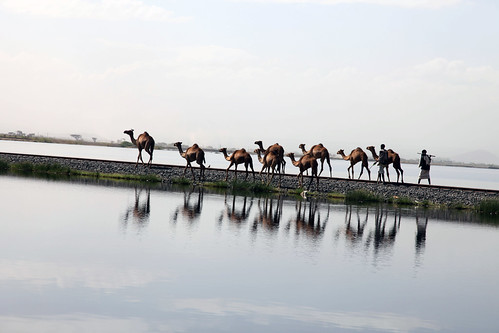
Camels in Methera area

A camel train in the Methera region of Oromia, Ethiopia (photo credit: ILRI/Apollo Habtamu).

We can shrink the carbon footprint of livestock,
but we need to properly measure their emissions first.

Written by Polly Ericksen, program leader at the International Livestock Research Institute (ILRI).

‘The good news is that the Paris Agreement to tackle global warming has come into force today ahead of the COP22 climate summit in Morocco, marking an unprecedented milestone in international cooperation to protect the planet.

‘The bad news is that the current pledges countries have made to reduce greenhouse gas emissions, as they stand, are insufficient to meet the goal of preventing global temperatures from increasing by more than 2°C above pre-industrial levels. It’s like the world has signed up to the gym, but hasn’t made it there to exercise yet. . . .

One thing is certain:

If we are to have any chance of success,

View original post 649 more words

Posted in Poverty, Hunger, Malnutrition | Leave a comment

OPINION: The increase of labor-saving machinery and the present state of Nigerian Agriculture, a challenge or not a challenge?

Posted in Poverty, Hunger, Malnutrition | Leave a comment

Improving Agricultural Productivity in Nigeria to Boost the Economy and Create Employment

Posted in Poverty, Hunger, Malnutrition | Leave a comment

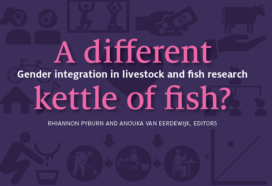
Gender integration in livestock and fish research

Peter Ballantyne (ILRI)'s avatarCGIAR Research Program on Livestock and Fish

Between 2012 and 2016, the Livestock and Fish program’s Gender Initiative supported an integrated approach to gender in its technical research.

Today in Cali, Colombia, the CGIAR Gender and Agriculture Research Network Annual Meeting launches a book about these experiences, showing that attention to gender equality and an understanding of gender dynamics leads to better science, more effective interventions and more inclusive development.

More information on the Cali event

The Book and supporting materials will be online in November 2016

View original post

Posted in Poverty, Hunger, Malnutrition | Leave a comment

HOW MUCH ASSISTANCE ARE FARMERS REALLY GETTING FOR THEIR AGRO-STARTUP

Posted in Poverty, Hunger, Malnutrition | Leave a comment

UN endorses recommendations on sustainable agricultural development for food security and nutrition, including the role of livestock

Susan MacMillan's avatarILRI news

13cattle

The Policy Round Table of the Committee on World Food Security (CFS), meeting in Rome on 17 Oct 2016, discussed the report on Sustainable Agricultural Development for Food Security and Nutrition: What Roles for Livestock? The report had been launched on 1 July in Rome and is now available in all of the UN languages.

Delia Grace, a scientist and program leader at the International Livestock Research Institute (ILRI), served as a member of the High-Level Panel of Experts that produced the livestock report that was finalized this week at the Rome CFS meeting; other ILRI researchers made other substantive contributions.

The Plenary Session of the Committee endorsed a set of recommendations, drafted during preliminary negotiations led by Ambassador Yaya Olaniran (Nigeria).

Proposed draft recommendations
on sustainable agricultural development
for food security and nutrition,
including the role of livestock

1. The following recommendations have been elaborated building…

View original post 1,673 more words

Posted in Poverty, Hunger, Malnutrition | Leave a comment

A first look at ILRI’s new research programs: Sustainable Livestock Systems

Susan MacMillan's avatarILRI news

BETTER SCIENCE, BETTER LIVES
The International Livestock Research Institute (ILRI),
headquartered in Africa and working in poor countries
worldwide to provide better lives through livestock,
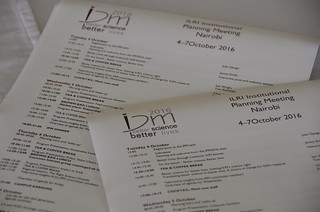
held its Institute Planning Meeting from 4 to 7 Oct 2016.
This is the sixth of a series of blog articles reporting on
plans for ILRI research programs, including ILRI’s
work in west and southern Africa and south, east and southeast Asia.

IPM 2016 agenda

A central question for ILRI’s Sustainable Livestock Systems program is:
‘What does “sustainable intensification” mean in different contexts?’
—ILRI’s Ben Hack reporting on #ipm2016

ILRI Sustainable
Livestock Systems Program

Polly Ericksen introduced the Sustainable Livestock Systems program by saying that the group of 28 ILRI scientists and some 40 research and other support staff provide data on the environmental footprint of livestock production (e.g. African greenhouse gas emissions data), help partners to design incentives to take up strategies for better environmental management of livestock…

View original post 494 more words

Posted in Poverty, Hunger, Malnutrition | Leave a comment

Advances in Food Security and Sustainability

FoodGovernance's avatarFood Governance

advance-in-food-securityThe first volume of Advances in Food Security and Sustainability has been released. I have contributed a chapter on the post-political condition and global food security governance.

Description

Advances in Food Security and Sustainability takes a scientific look at the challenges, constraints, and solutions necessary to maintain a healthy and accessible food supply in different communities around the world. The series addresses a wide range of issues related to the principles and practices of food sustainability and security, exploring challenges related to protecting environmental resources while meeting human nutritional requirements.

Key Features

  • Contains expertise from leading contributions on the topics discussed
  • Covers a vast array of subjects relating to food security and sustainability

Table of Contents

View original post 307 more words

Posted in Poverty, Hunger, Malnutrition | Leave a comment

SIMPLE STRATEGIES FOR PROFITABILITY IN YOUR AGRIBUSINESS

Posted in Poverty, Hunger, Malnutrition | Leave a comment

Agricultural approaches that improve livelihoods

Willem Van Cotthem's avatarDESERTIFICATION

Photo credit: Pixabay

Farmers of the Benna tribe in Ethiopia


CCAFS, CTA Demonstrate Value of Climate-Smart Agriculture in Africa


The Technical Centre for Agricultural and Rural Cooperation (CTA) and CGIAR Research Program on Climate Change, Agriculture and Food Security (CCAFS) released a book highlighting climate-smart agricultural practices across Africa, based on eight case studies. The book intends to increase awareness of, and support for, agricultural approaches that improve livelihoods and enhance food security while contributing to climate change mitigation.

The case studies cover:

  • farmer-managed natural tree regeneration;
  • improved market access for dairy products;
  • a transboundary tree restoration initiative;
  • tree use for drought resistance;
  • a regional project for the promotion of fruit trees;
  • and tree planting and agricultural extension programmes to enhance agroforestry.

Read more: land-l.iisd


View original post

Posted in Poverty, Hunger, Malnutrition | 1 Comment

How to increase agricultural productivity and enhance drought resilience

Willem Van Cotthem's avatarDESERTIFICATION

Photo credit: CCAFS – CGIAR

Exchange meeting with farmers on farmer-managed natural regeneration in Niger. Photo: P. Savadogo
(view original)

A real opportunity to scale up Climate-Smart Villages in Niger

In Niger, the World Bank is financing a project inspired by the Climate-Smart Village model of Kampa Zarma.

by Mathieu Ouédraogo (CCAFS West Africa)

In August, the 3N (Nigeriens Nourish Nigeriens) facilitated a formulation workshop of a climate-smart agriculture project in Niger. The CGIAR Research Programme on Climate Change, Agriculture and Food Security (CCAFS) West Africa programme was among the attendees of the workshop, which was led by the 3N High Commission in partnership with the World Bank.

About the World Bank-funded CSA project in Niger

Led by the 3N High Commission of Niger, it is a seven year-long project (from 2016 to 2023) with a total budget of USD 111 million. The objective is to…

View original post 199 more words

Posted in Poverty, Hunger, Malnutrition | 1 Comment

Sustainable agricultural development for food security and nutrition

Willem Van Cotthem's avatarDESERTIFICATION

13cattle https://news4ilri.files.wordpress.com/2016/10/13cattle.png?w=500&h=500

UN endorses recommendations on sustainable agricultural development for food security and nutrition, including the role of livestock

View original post 14 more words

Posted in Poverty, Hunger, Malnutrition | 1 Comment

OPINION: Livestock Mechanization, Reproduction should not be an exemption PART 1

Posted in Poverty, Hunger, Malnutrition | Leave a comment

Livestock count: Live reporting from the 43rd session of the Committee on World Food Security

Susan MacMillan's avatarILRI Clippings

This article was posted originally on 19 Oct 2016

cowPhoto credit: Dominik Schraudolf on Pixabay

Article by Ksenija Simovic, #CFS43 Social Reporter: ksenijasimovic(at)gmail.com

‘This week marked a milestone for the Committee on World Food Security (CFS). For the first time since its reform, it recognized the role of livestock in addressing malnutrition, sustainable agriculture and climate change.

‘Two years ago CFS asked the High-Level Panel of Experts to prepare a report on sustainable agricultural development for food security and nutrition, including the role of livestock. The report was presented and endorsed at the 43rd plenary session of the CFS in Rome this week and many of members took the stage to state their positions in regards its recommendations.

‘The extensive discussions taking place these days around the topic of sustainable livestock production and nutrition highlight just how complex the issues are. Until just a few years ago…

View original post 294 more words

Posted in Poverty, Hunger, Malnutrition | Leave a comment

The ‘big bet’ on chickens for Africa

Susan MacMillan's avatarILRI Clippings

Chickens kept by a local farmer in the village of Morrumbala

Local hen and her chick in a village of Mozambique, where production costs for farmers are 30% higher than the cost of importing chicken (photo credit: ILRI/Stevie Mann).

With a growing appetite for chicken in Africa, BBC Africa’s Kim Chakanetsa investigates why the continent does not produce enough birds to feed itself.

‘If you have eaten a handful of spicy chicken wings in Angola recently or perhaps polished off a lemony “yassa poulet” in Senegal, there is a good chance your chicken travelled some distance before finding its way on to your plate.

‘It depends where you live in Africa, but chickens are increasingly migrating—in freezers—from Brazil, Germany or other European Union countries to the continent.

Imports of chicken to sub-Saharan Africa tripled between 2004 and 2014,
according to figures from the US Department of Agriculture.

‘Here’s a look at reasons behind the huge increase and what can be done…

View original post 570 more words

Posted in Poverty, Hunger, Malnutrition | Leave a comment

Jimmy Smith: On the LiveSTOCK Exchange ‘hard seat’

Peter Ballantyne (ILRI)'s avatarILRI Clippings

During the November 2011 ‘liveSTOCK Exchange’ event at ILRI, Brian Perry interviewed Jimmy Smith, Director of the International Livestock Research Institute (ILRI).

Watch the video:


On 9 and 10 November 2011, the ILRI Board of Trustees hosted a 2-day ‘liveSTOCK Exchange’ to discuss and reflect on livestock research for development. The event synthesized sector and ILRI learning and helped frame future livestock research for development directions.

The liveSTOCK Exchange also marked the leadership and contributions of Dr. Carlos Seré as ILRI Director General.  See all posts in this series / Sign up for email alerts

View original post

Posted in Poverty, Hunger, Malnutrition | Leave a comment

‘Livestock is the Cinderella of agricultural development’–An interview with Jimmy Smith

Susan MacMillan's avatarILRI Clippings

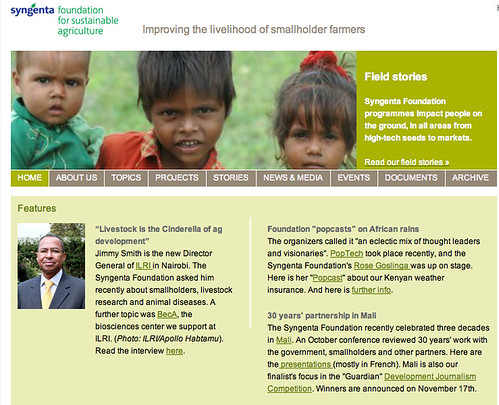
Jimmy Smith interview on Syngenta Foundation website

A lengthy interview with ILRI’s new director general Jimmy Smith is the leading post on the home page of the Syngenta Foundation website in Nov 2011 (image credit: Syngenta Foundation; credit for photo of Jimmy Smith: ILRI/Apollo Habtamu).

‘Jimmy Smith is the new Director General of [the International Livestock Research Institute] in Nairobi. He recently talked to the Syngenta Foundation about smallholders, livestock research and animal diseases. A further topic was BecA, the biosciences center that the Foundation supports at ILRI.

Syngenta Foundation
‘How do you view the global importance of livestock?

Jimmy Smith
‘The world is at an interesting stage with regard to food and nutritional security! There is much concern about how farmers can feed two billion more people in 2050. And unfortunately we’re not starting from zero. We already have a billion who are hungry and poor. So we’re really talking about nourishing three billion more people…

View original post 1,065 more words

Posted in Poverty, Hunger, Malnutrition | Leave a comment

The triple challenge facing livestock research for development in Africa

ILRI Communications's avatarILRI Clippings

For the November 2011 ‘liveSTOCK Exchange’ event at ILRI, Tim Williams – Africa Director at the International Water Management Institute (IWMI) reflects on ILRI’s livestock work in West Africa …

Two key questions
Back in 2000, two key questions occupied the minds of those of us who worked on the development of the ILRI’s Strategy–Livestock: A Pathway out of Poverty—Where are the poor livestock producers located and how can livestock research be applied to lift them out of poverty in an environmentally sustainable way? Ten years on, it is pertinent to review how ILRI has dealt with these two questions.

While the institute satisfactorily answered the first question, dealing with the second question remains a work in progress. To be sure, notable achievements have been recorded in linking livestock producers, particularly dairy producers to markets, in improving crop-livestock integration to increase food output and enhance soil fertility and…

View original post 702 more words

Posted in Poverty, Hunger, Malnutrition | Leave a comment

The omnivore’s dilemma: ‘High-steaks’ livestock decisions at next week’s Committee on World Food Security (#CFS43)

Susan MacMillan's avatarILRI Clippings

Cattle being watered at the Ghibe River in southwestern Ethiopia

Cattle being watered at the Ghibe River in southwestern Ethiopia (photo credit: ILRI/Stevie Mann).

Is it OK to keep eating meat? Or even milk, cheese and eggs?

‘It’s almost guaranteed that this topic will come up whenever dinner table conversation turns to sustainability. Livestock production has been implicated in many of our biggest environmental challenges, from climate change to deforestation to the critical state of many coastal ecosystems.

‘At the same time, animal-sourced foods are excellent sources of protein and other nutrients essential for mental and physical development, especially in young children; not to mention being in high demand among the burgeoning middle classes of emerging economies.

‘So, how do we reconcile our nutritional needs and our taste for animal-based foods with environmental sustainability?

This year’s report by the UN High-level Panel of Experts on Food Security and Nutrition (HLPE), which will be discussed during the 43rd session of…

View original post 506 more words

Posted in Poverty, Hunger, Malnutrition | Leave a comment

Mediterranean Youth aims at fighting marginalization with agriculture

GFAiR's avatarThe GFAiR Blog

22775347451_cd212ca4d3_o

We hadn’t left the Milan Congress 2015 when the YPARD’s Mediterranean team – a group of 25 agriculturists from the South and the North Mediterranean- got together and said: “This was a very rich experience of South-North Mediterranean dialogues for rural development upon which we can reflect, and the discussions and outcomes really highlighted the key role of young people as agents of change in the region. But we can also see limitations in the way we discussed during the congress. So, we would like to propose a new model for the 2018 Congress to boost dynamic interactions among partners.’’

Since then, the YPARD Mediterranean chapter has been taking part in further discussions with current and emerging partners and initiatives leaders towards a series of 2016-2018 Dialogues and a set of actions for better livelihoods in the region.

The team’s objective is to make sure that youth are partof the…

View original post 847 more words

Posted in Poverty, Hunger, Malnutrition | Leave a comment

Amidst change, a time to take stock of livestock science to reduce poverty

Peter Ballantyne (ILRI)'s avatarILRI Clippings

Carlos (18)

Carlos Seré, former director general of the International Livestock Research Institute (ILRI) (photo credit: ILRI).
This week in the Ethiopia capital of Addis Ababa, the first board meeting of the International Livestock Research Institute (ILRI) with participation by Jimmy Smith, ILRI’s new director general, is coinciding with a last farewell to ILRI’s outgoing director general, Carlos Seré, and his wife, Chrysille Seré.

ILRI thought this an appropriate moment not only to take stock of the ‘Seré legacy’, generated over ten years of Seré’s leadership, but also to take a snap shot of where ILRI is now, and to look ahead to where the institute should be headed in future, under Jimmy Smith’s leadership.

Highlights from the ILRI Board
In a live-streamed report back to staff by the board yesterday, Board Chair Knut Hove first welcomed Cheikh Ly to the ILRI Board of Trustees.

Ly, who serves as Regional Animal Production…

View original post 1,028 more words

Posted in Poverty, Hunger, Malnutrition | Leave a comment

Livestock are coming to the fore of sustainable development to-do lists

Susan MacMillan's avatarILRI Clippings

Dubuffet_CowWithTwoTrees

Jean Dubuffet, Vache aux deux arbres (Cow with two trees), 1943, Jonathan Novak Contemporary Art.

This week, Shirley Tarawali, assistant director general of the International Livestock Research Institute (ILRI), will participate in a panel discussion and launch organized by the Livestock Global Alliance, of which ILRI is one of five members. The other four members are other public institutions with a focus on livestock: the Food and Agriculture Organization of the United Nations (FAO), the International Fund for Agricultural Development (IFAD), the World Organisation for Animal Health (OIE) and the World Bank.

The Livestock Global Alliance event will take place on Thu, 26 May 2016, during the 84th General Session of the World Assembly of OIE Delegates, being held this week (22–27 May 2016) in Paris.

What will be raised at the Livestock Global Alliance event? Well, some good (if counterintuitive)…

View original post 771 more words

Posted in Poverty, Hunger, Malnutrition | Leave a comment

Better livestock policies in Africa offer a pathway out of poverty

Susan MacMillan's avatarILRI Clippings

Boran Cattle

Boran cattle in Yabello, Ethiopia (photo credit: ILRI/ Camille Hanotte).

By Thumbi Mwangi, Washington State University

A majority of rural households in Africa keep different livestock species. But only a small proportion can afford to keep good quality livestock. This is mainly due to a combination of low government funding and the poor policies of external funders.

Those that do have livestock are faced with the challenges of infectious disease and ill-conceived breeding programmes. This means that they rarely achieve optimum production to meet their household’s economic and nutritional needs.

Households that keep livestock earn higher incomes, accumulate more wealth and consume more animal-sourced foods. They are also more able to pay for healthcare than households without animals.

I grew up on a small farm in rural Kenya. Although my parents earned government salaries working as civil servants, my education was largely paid for by my father’s livestock herd.

View original post 736 more words

Posted in Poverty, Hunger, Malnutrition | Leave a comment

3rd PAFO Continental Briefing Advancing African agriculture through agribusiness development

ctabrussels's avatarBrussels Development Briefings

3rd PAFO Continental Briefing

Advancing African agriculture through agribusiness development

28-29 November 2015, Durban, South Africa

 Organised by the Panafrican Farmer’s Organisations (PAFO) and the ACP-EU Technical Centre for Agricultural and Rural Cooperation (CTA)

Organised in the context of the GFIA

3rd Continental Briefing Logo

Twitter: @ctaflash @ctabrussels #ContBrief #GFIAAfrica
Watch Statistics

This Briefing is linked to the Brussels Briefings organized by the CTA, EC/DGDEVCO, ACP Group and Concord every two months on key issues related to agriculture in ACP countries.

The continent’s leaders have renewed their commitment to transforming agriculture as a driver of job creation, improved incomes, and access to nutritious food.  The Heads of State and Government of the African Union met at the 23rd Ordinary Session of the AU Assembly in Malabo, Equatorial Guinea, from 26-27 June 2014, on the Theme of the African Year of Agriculture and Food Security: “Transforming Africa’s Agriculture for Shared Prosperity…

View original post 882 more words

Posted in Poverty, Hunger, Malnutrition | Leave a comment

4th African Continental Briefing – Youth & Agribusiness

ctabrussels's avatarBrussels Development Briefings

4th PAFO Continental Briefing and 1st PAFO Youth Forum

logos-for-4th-pafo-briefing

 The future of African farming and agribusiness:
New opportunities for youth

   6th-9th October 2016, Accra, Ghana

In the context of the African Agribusiness Incubators Network Conference and Expo 2016
MPlaza Hotel

Twitter: use  #AAINTSB  + #ContBrief  & follow @CTAflash 


Organised by the Panafrican Farmer’s Organisation (PAFO) and the ACP-EU Technical Centre for Agricultural and Rural Cooperation (CTA)
With the partnership of AgriCord

This Briefing is linked to the Brussels Briefings organized by the CTA, EC/DGDEVCO, ACP Group and Concord every two months on key issues related to agriculture in ACP countries

RESOURCES

Read about CTA at the 2nd Pan African Agri-Business Incubators Conference and Expo
Biodata of the Speakers (coming soon)
Photos (coming soon)

More Info:
Brussels Briefing 45: Smart Farming in Africa (July 2016, Brussels)
– 3rd African Continental Briefing:  Agribusiness…

View original post 1,522 more words

Posted in Poverty, Hunger, Malnutrition | Leave a comment

Trees for the Future and the Forest Garden Program — DESERTIFICATION

Dr Raziq Kakar's avatarPastoralists, Nomads, Small and Medium Scaled Family Farmers are the Custodian of Native genetic resources and Sustainable Farming Systems

Photo credit: Trees for the Future In Mbentinki, Senegal, women gather around to fill planting sacks for their new nursery. Desertification: Rooting out the Problem with Trees Article Post Written by Amanda Grossi, Trees Contributing Columnist More than 1.5 billion people in the world depend on degraded land, and about three quarters (74%) of […]

via Trees for the Future and the Forest Garden Program — DESERTIFICATION

View original post

Posted in Poverty, Hunger, Malnutrition | Leave a comment

Farming techniques must adapt to mitigate the effects of climate change and ensure global food security (GlobalHealth / Kaiser Foundation)

Willem Van Cotthem's avatarDESERTIFICATION

Read at :

http://globalhealth.kff.org/Daily-Reports/2010/October/18/GH-101810-Food-Security.aspx?utm_source=feedburner&utm_medium=feed&utm_campaign=Feed%3A+kff%2Fkdghpr+%28Kaiser+Daily+Global+Health+Policy+Report%29

Shift In Agriculture Techniques Required To Ensure Future Food Security, U.N. Special Rapporteur On Right To Food Says On World Food Day

Farming techniques must adapt to mitigate the effects of climate change and ensure global food security, Olivier De Schutter, the U.N. special rapporteur on the right to food, said in a statement to mark Saturday’s World Food Day, Agence France-Presse reports.

“As a result of climate change, the yields in certain regions of sub-Saharan Africa are expected to fall by 50 percent by 2020 in comparison to 2000 levels. And growing frequency and intensity of floods and droughts contribute to volatility in agricultural markets,” according to the statement. “Current agricultural developments are … threatening the ability for our children’s children to feed themselves,” De Schutter said. “A fundamental shift is urgently required if we want to celebrate World Food Day next year,” he added…

View original post 557 more words

Posted in Poverty, Hunger, Malnutrition | Leave a comment

Access to farm machinery is key for agricultural productivity

Willem Van Cotthem's avatarDESERTIFICATION

Photo credit: FAO

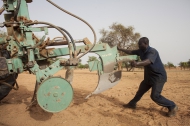
A worker adjusts a plough attachment in Djibo, Burkina Faso. Spare parts must be available for tractors to be useful.

Sustainable mechanization has much to offer in sub-Saharan Africa

Feeding the burgeoning world population will require significant improvements in agricultural productivity, above all in Africa, and mechanization and appropriate mechanization strategies have a large role to play, according to a new report from FAO.

The opportunity must be guided in a way that meets smallholder farmers’ needs and that does not require a Green-Revolution type of approach with high levels of agrochemical inputs and destructive ploughing operations that threaten soil health and fertility, according to FAO’s new report.

(see also: http://www.fao.org/3/a-i6167e.pdf)

Agricultural mechanization: A key input for sub-Saharan African smallholders underlines that agricultural mechanization in the twenty-first century should be environmentally compatible, economically viable, affordable, adapted to local conditions and, in view of current developments in…

View original post 90 more words

Posted in Poverty, Hunger, Malnutrition | Leave a comment

Newly approved CGIAR Portfolio sets agenda for next generation agriculture research for development

Willem Van Cotthem's avatarDESERTIFICATION

Photo credit: CIMMYT

CGIAR system retools to fight hunger and climate change

CGIAR, a global research partnership for a food-secure future, dedicated to reducing poverty, enhancing food and nutrition security, and improving natural resources and ecosystem services, today announced the approval of a new, targeted research portfolio to boost poor farmer incomes, food availability and resilience in the face of climate change in developing countries.

“Food demand is set to rise by at least 20 percent globally over the next 15 years, with the steepest increases in Africa, South Asia and East Asia,” said Juergen Voegele, Senior Director of the World Bank’s Agriculture Global Practice and Chair of the CGIAR System Council. “CGIAR and its network of 15 research centers is ideally positioned to deliver the suite of new agricultural technologies that are climate-smart, nutrition-sensitive and pro-poor.”

Upon the recommendation of the System Management Board, the CGIAR System Council carefully…

View original post 219 more words

Posted in Poverty, Hunger, Malnutrition | Leave a comment

Safe Food, Fair Food project research presented at tropical veterinary medicine conference

Tezira Lore's avatarSafe Food, Fair Food

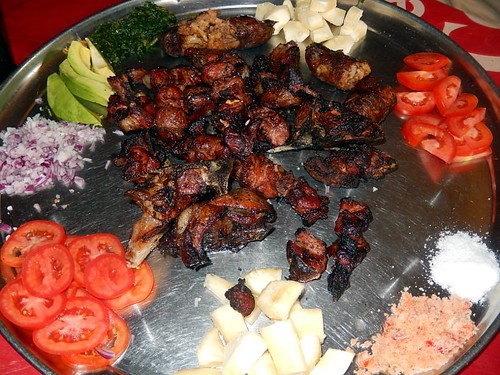
Plate served with fried pork Serving of fried pork and raw relishes in a pork joint in Kampala, Uganda (photo credit: ILRI/Martin Heilmann).

Research findings from the Safe Food, Fair Food project were presented at the first joint international conference of the Association of Institutions for Tropical Veterinary Medicine (AITVM) and the Society of Tropical Veterinary Medicine (STVM) which was held in Berlin, Germany on 4–8 September 2016.

AITVM is a foundation of 24 veterinary faculties and livestock institutes based in Africa, Asia and Europe with the mandate to improve human health and quality of life by means of increased and safe food production in tropical regions through enhancement of research, training and education in veterinary medicine and livestock production within the framework of sustainable development.

STVM is made up of scientists, veterinarians and students from more than 40 countries with common interests in tropical veterinary medicine. It is a non-profit organization whose purpose is…

View original post 172 more words

Posted in Poverty, Hunger, Malnutrition | Leave a comment

Opening Agricultural Data: Going Beyond Access

GFAiR's avatarThe GFAiR Blog

open-hero

I recently participated in the GODAN Summit. What really struck me was that every speaker at the summit, especially those who spoke at the plenaries, recognised that “Open Data” is much more than opening access to data. They all stressed that it is about managing data from generation to effective use, about equity in its ownership, use and benefits from data use and about economic and social responsibility as generators, managers, custodians and users of data.

The three GODAN papers[i] released at the Summit significantly enlarged the dialogue on open data. There was the key recognition that in an agriculture that is increasingly become knowledge intensive and where decisions need to be made on accurate, reliable information, data is an invaluable resource. Within this recognition was also the fact that there exists severe resource inequality and that resource poor smallholder farmers are also the ones who have poor…

View original post 525 more words

Posted in Poverty, Hunger, Malnutrition | Leave a comment

Facilitating market linkages—LIVES project approaches and lessons learned

James Stapleton's avatarLIVES-Ethiopia

Taking a value chain approach is essential to the livelihoods of smallholder farmers in Ethiopia, according to scientists working at International Livestock Research Institute project (ILRI). Making smallholder producers more aware of market opportunities will help them make reasonable returns on their investments. Key to this process is the role of market-oriented extension services, facilitating marketing services to smallholder farmers and their enterprises to help improve their incomes.

Download the poster: Legesse, D. 2016. Facilitating market linkages—LIVES project approaches and lessons learned. Poster. Addis Ababa, Ethiopia: ILRI.

View original post

Posted in Poverty, Hunger, Malnutrition | 1 Comment

Poster highlight of LIVES approach to smallholder market oriented agricultural development

Fanos Mekonnen's avatarLIVES-Ethiopia

This poster, prepared for the ILRI@40 series of events, gives an overview of the Livestock and Irrigation Value Chains for Ethiopian Smallholders (LIVES) project approaches and strategies as well as the project outputs from January 2013 to October 2014.

The LIVES project approach, which is based on innovation systems, has five major intervention components: Capacity development, knowledge management, promotion, value chain development and research and documentation.

Visit ilri.org/40 for more information.

Follow #ilri40 on Twitter.

View original post

Posted in Poverty, Hunger, Malnutrition | Leave a comment

Capacity development for market-oriented agricultural development

James Stapleton's avatarLIVES-Ethiopia

Capacity development plays a critical enabling role in facilitating the adoption and scaling out of value chain development interventions and approaches by addressing attitudinal, knowledge and skills gaps in value chain actors, service providers and value chain supporters.

A recent poster by scientists at International Livestock Research Institute (ILRI) highlights capacity development approaches to market-oriented expansion taken in the Livestock and Irrigation Value chains for Ethiopian Smallholders (LIVES) project. Increasing the skills and knowledge and increasing the sharing of this knowledge will help farmers to receive a greater income. Offering farmers, a pathway to prosperity.

Download the poster: Lemma, M., Hoekstra, D., Gebremedhin, B. and Tegegne, A. 2016. Capacity development for market-oriented agricultural development: Approaches, experiences and lessons learned. Poster. Addis Ababa, Ethiopia: ILRI.

View original post

Posted in Poverty, Hunger, Malnutrition | Leave a comment

Bridging the knowledge and skills gaps: lessons from LIVES capacity development approaches

Beamlak Tesfaye's avatarLIVES-Ethiopia

by Mamusha Lemma  

LIVES_Logo

Throughout its activities in Ethiopia, the Livestock and Irrigation Value Chains for Ethiopian Smallholders (LIVES) project has used participatory processes to design capacity development interventions that assess the knowledge and skills gaps in value chain actors and service providers.

Implemented through training, coaching and mentoring, study tours, and self-learning materials, among other strategies, these interventions have been characterized by experimenting with different capacity development approaches in different regions based on local needs.

Collective exploration and lessons from these tests have helped refine further and articulate more clearly the best capacity development approaches. ToT training, mixed group training, couples training, study tours, and coaching and mentoring have emerged as the most effective ways of developing the knowledge and skills of value chain actors and service providers.

Some of the project’s findings have corrected previous assumptions including the expectation that coaching and mentoring would be conducted only after training activities to support knowledge and skills application. In some areas, study tours followed…

View original post 763 more words

Posted in Poverty, Hunger, Malnutrition | Leave a comment

World’s farmers unite to tackle antimicrobial resistance

GFAiR's avatarThe GFAiR Blog

OLYMPUS DIGITAL CAMERABy Marco Marzano de Marinis, Secretary General, World Farmers’ Organisation

Antimicrobial resistance, often referred to as AMR, is an increasingly serious threat to global public health.

As the international community is now on the way to implement the Sustainable Development Goals and the 2030 Agenda, there is still an urgent need to increase attention and policy coherence at the international, regional and national levels. Implementation of Goal 3, however, demands a change in mindset from addressing singular issues to taking a more systematic, multi-stakeholders’ approach. Addressing the global nature of many health issues will also be critical to our success. Getting many actors and sectors to coordinate their work with others to achieve a common goal is difficult.

World leaders gathered at the UN headquarters on Wednesday for a high-level meeting on antimicrobial resistance to explore the growing threat of infections that no longer respond to the drugs used to treat…

View original post 402 more words

Posted in Poverty, Hunger, Malnutrition | Leave a comment

Fostering food and nutrition security is key to sustainable development

Willem Van Cotthem's avatarDESERTIFICATION

Food and nutrition security key to Africa’s development

by Gilbert Nakweya bb9e69386f2d71ee1687c3e38927b131

Fostering food and nutrition security is key to sustainable development. But access to high quality seeds from research and development by smallholder farmers is still a major challenge to agricultural productivity in Sub-Saharan Africa.

In fact, the second goal in the UN’s Agenda 2030 on Sustainable Development Goal is to end hunger, achieve food security and improved nutrition and promote sustainable agriculture.

But how much is Africa investing to improve food security? Is Africa committed to taking leadership in building resilient seed sector for improved food security? Th

Africa requires a continental effort in development of sustainable seed sector through leadership.

Gilbert Nakweya

ese were some of the issues I pondered over during the Integrated Seed Sector Development (ISSD) Africa Synthesis Conference in Kenya this week (19-20 September). The conference drew agricultural experts from all over the world to…

View original post 19 more words

Posted in Poverty, Hunger, Malnutrition | Leave a comment

Gender Dilemmas in Sustainable Development

FoodGovernance's avatarFood Governance

harcourt-lectureThe Wageningen University Gender & Diversity working group presents a lunch-time lecture on Gender Dilemmas in Sustainable Development

by Dr Wendy Harcourt

Date: Wednesday, October 12

Time: 12:30-13:30

Place: C68, de Leeuwenborch, Wageningen

Wendy Harcourt argues that feminist theory brings important political lessons to sustainable development. Her talk explores: development as transformative politics; intersectionality; and the inter-section of gender with sustainability issues. She argues that new methodologies are required in development that bridge the divide between practice-based analysis and universalising ‘global’ theory. She presents the case for why it is important to learn from those who are breaking new ground listening and learning from the perspectives of communities living and working on the margins of mainstream development.

Dr Wendy Harcourt is Associate Professor in Critical Development and Feminist Studies at the International Institute of Social Studies of the Erasmus University in The Hague. She is Research Programme Leader for the Civic…

View original post 86 more words

Posted in Poverty, Hunger, Malnutrition | Leave a comment